
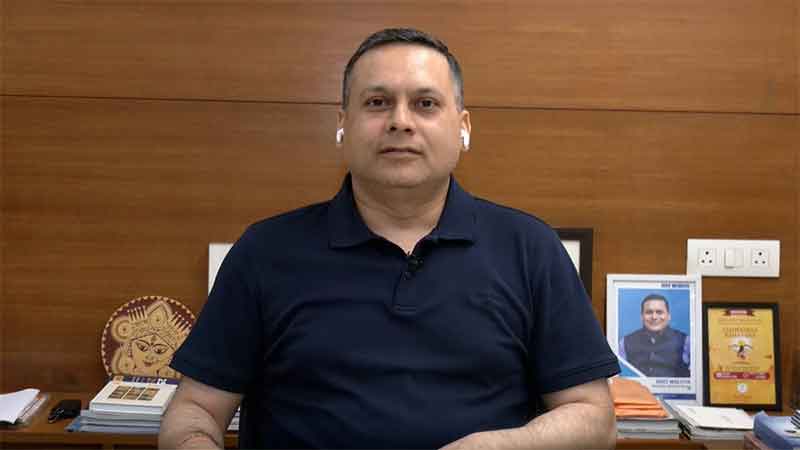
After 11 years at the helm of the BJP’s digital machine, Amit Malviya is gone. The party says little about why. But his removal comes at a politically revealing moment, when India’s digital battlefield has changed, young voters are challenging established political narratives, and misinformation has become one of the biggest threats to democratic discourse.
On August 17, 2026, the Bharatiya Janata Party announced its new national office-bearers under party president Nitin Nabin. Among the most consequential changes was the removal of Amit Malviya as head of the BJP’s IT Cell, a position he had held since 2015. He has been replaced by Deepak Mhaskey, an academic with experience in electoral data and digital strategy.
There was no dramatic public explanation. No admission of failure. No acknowledgment that the BJP’s digital strategy had gone wrong. No statement that the party had lost faith in its most recognisable digital warrior. Yet political organisations rarely move people who have occupied powerful positions for more than a decade without a reason.
And Malviya’s exit deserves to be read not simply as a personnel change, but as a possible verdict on a political communications model that has increasingly blurred the line between campaigning, propaganda, confrontation and misinformation.11 Years at the Centre of BJP’s Digital Machine
Malviya became national head of the BJP’s IT Cell in 2015, after the party’s historic 2014 election victory had demonstrated the extraordinary political power of digital communication. Under his tenure, the BJP developed one of India’s most formidable political communication operations. The objective was not merely to inform. It was to dominate the conversation.
Every statement from the Prime Minister could be amplified within minutes. Every opposition attack could be countered. Every government achievement could be packaged for social media. Hashtags could be pushed. Videos could be clipped. Narratives could be created and distributed through networks of supporters.
The strategy was undeniably effective in one respect: It changed the way Indian political parties fought elections. But effectiveness is not the same thing as credibility. And after a decade, the question facing the BJP is increasingly uncomfortable: Did its digital machine become too dependent on confrontation, outrage and narrative warfare?
The Man Became Bigger Than the Office
One interpretation is that Malviya’s central mistake was allowing his personal online identity to merge with the institutional voice of the party. A party IT chief is ideally invisible. The institution should speak louder than the individual.
But Malviya became a highly visible political actor on social media, frequently engaging in direct attacks on opposition leaders, journalists and critics. His account often functioned like a parallel newsroom issuing rapid responses, framing narratives, and escalating political exchanges in real time. This created a structural problem. When the messenger becomes part of the message, the distinction between individual and institution collapses.
· Every controversial post becomes a party controversy.
· Every correction becomes a reputational issue.
· Every online clash becomes institutional noise.
The messenger eventually becomes the story.
When Fact-Checking Became Part of the Narrative
The most persistent criticism of Malviya’s tenure is not simply aggressiveness — which is common in politics but the frequency with which his posts were challenged by fact-checkers. Independent platforms such as Alt News and Scroll documented multiple instances where claims shared from his account were disputed or labelled misleading. These are journalistic assessments, not judicial findings, but they contribute to a broader pattern of contested communication.
In 2020, Twitter labelled one of his posts related to the farmers’ protest as “manipulated media.” That incident became symbolic because it showed a senior political figure’s content being publicly flagged by a global platform. This shifts the debate. Political communication is expected to be persuasive, even selective. But when it repeatedly enters disputed factual territory, the question changes: Not “Is it effective?” but “What does it do to public trust?”
India’s Misinformation Environment Is Expanding
This concern is not theoretical. The Reuters Institute’s Digital News Report 2026 found that 52% of Indian respondents sometimes or often avoid news, while overall trust in news fell to 39%. It also noted that more than half of respondents rely on social media for news consumption. The 2025 report highlighted that WhatsApp is widely perceived as a major source of misinformation risk in India, reflecting the platform’s role in political communication networks.
These findings come with an important limitation: the sample is not fully representative of India’s population. But the trend is still clear. India’s political information ecosystem is becoming increasingly digital, decentralised and fragmented. In such an environment, those who manage political communication systems hold enormous influence but also enormous responsibility.
Trust in Political Messaging Is Low
The Lokniti-CSDS 2024 survey adds another layer. Only 11% of respondents said they trusted political messages on social media “a lot.” A larger share expressed only moderate trust, while a significant portion expressed little or no trust at all. This reveals a key contradiction in modern politics:
· Reach is not trust.
· A message can go viral and still fail to convince.
· A hashtag can trend and still not shift opinion.
· A video can dominate timelines and still collapse under scrutiny.
· Over time, voters are becoming more sceptical of political content online, not less.
The 2024 Election Marked a Turning Point
By the 2024 general election, India’s digital ecosystem had changed significantly from the 2014 landscape. The BJP still had a strong online presence, but it was no longer unchallenged. Opposition parties had improved their digital strategies. Independent creators and YouTubers had become influential political voices. Fact-checking organisations had greater visibility.
And younger voters were consuming political content across multiple platforms rather than relying on television narratives. The Reuters Institute has also noted the growing importance of YouTube, Instagram and WhatsApp as news sources in India. The result is a fragmented information environment where no single actor can fully control the narrative. Everyone can now contest the story.
The Farmers’ Protest Episode as a Warning
One of the most widely discussed controversies during Malviya’s tenure came during the farmers’ protests. In 2020, Twitter flagged one of his posts as manipulated media. The incident became significant not because of the post alone, but because it demonstrated a shift in how digital platforms engage with political content.
Platforms are no longer passive distributors. They are active moderators. This changes the rules of political communication. Old assumptions that a message once posted will circulate uncontested no longer hold.
Today, content can be:
- Fact-checked within minutes
- Reverse-searched
- Contextualised
- Debunked publicly
The digital space that once amplified political messaging now also exposes it to immediate scrutiny.
The Karnataka FIR Episode
In 2024, an FIR was filed against BJP leaders, including Malviya, over a social media video alleged to have been misleading in its framing of welfare distribution and community targeting. An FIR is not a conviction, and the allegations remain legally unproven. But politically, such incidents accumulate into reputational pressure. They also highlight a broader issue: when political messaging touches sensitive social fault lines, the consequences extend beyond electoral debate. They can deepen mistrust between communities.
The Problem of Political Personality
Another controversy in 2024 involved allegations made by an RSS-linked individual, which Malviya denied and challenged legally. The matter did not result in any proven wrongdoing, but it reinforced a pattern: Malviya was no longer just a background strategist. He had become a public political figure in his own right. This matters because it changes the role of an IT cell chief. Instead of being a behind-the-scenes operator, he became part of the political battlefield itself.
The Rise of Youth-Led Digital Politics
By 2026, a new form of political expression had emerged among younger Indians. Movements like the so-called “Cockroach Janta Party” protests reflected a shift toward meme-driven, decentralised political mobilisation focused on unemployment, education and institutional accountability. These movements rely less on formal organisation and more on digital culture:
· Memes, satire, short videos, parody and viral storytelling.
· This represents a fundamental shift.
· Political communication is no longer top-down.
· It is participatory, reactive and often unpredictable.
A New Digital Battlefield
The BJP’s early success in digital politics was built on speed, coordination and narrative control. But the current environment is different.
Now:
- Narratives are instantly challenged
- Opposition voices are amplified by creators
- Misinformation is rapidly exposed
- Memes can undermine official messaging
The old model of communication centralised, hierarchical and controlled is increasingly difficult to sustain.
The Deeper Issue: Trust
The most important consequence of prolonged digital political warfare is not electoral advantage or loss. It is trust erosion. When political communication repeatedly blurs fact and interpretation, citizens begin to doubt all sources including official ones. The Reuters Institute’s trust figures and Lokniti-CSDS findings both point toward a broader crisis: declining confidence in political messaging and news ecosystems. This is not just a media problem. It is a democratic one.
What Malviya’s Exit Really Signals
It would be simplistic to interpret Malviya’s removal as either punishment or vindication. The BJP has not publicly framed it as either. It may reflect organisational restructuring, generational change, or strategic recalibration. But symbolically, it suggests something important: The BJP recognises that the digital environment it once dominated is no longer stable or predictable. However, it has a larger lesson. The real issue is not one individual. It is the system of incentives that defines political communication today. If speed is rewarded over accuracy, misinformation will spread.If outrage performs better than nuance, outrage will dominate. If engagement matters more than credibility, credibility will decline. Replacing individuals does not change these structural pressures.
Conclusion
Amit Malviya’s exit marks the end of a long phase in India’s digital political evolution one defined by aggressive messaging, rapid amplification and narrative control. But that phase is already over. The new digital ecosystem is more fragmented, participatory and far less predictable, where political messaging is instantly challenged, reinterpreted and often dismantled by competing voices online. In this environment, no party can fully dominate the narrative the way it once could.
Voters are no longer passive recipients of political communication. They are active participants who question, fact-check, remix and sometimes reject official messaging altogether. This shift has weakened the effectiveness of centralised propaganda models and increased the importance of credibility over speed.
Seen in this light, Malviya’s departure is not just an organisational reshuffle. It reflects a broader recognition that the rules of political communication have changed. The real challenge for the BJP, for all parties and is no longer amplification, but rebuilding trust in an age where truth itself is constantly contested in real time.
Credit: countercurrents.org