
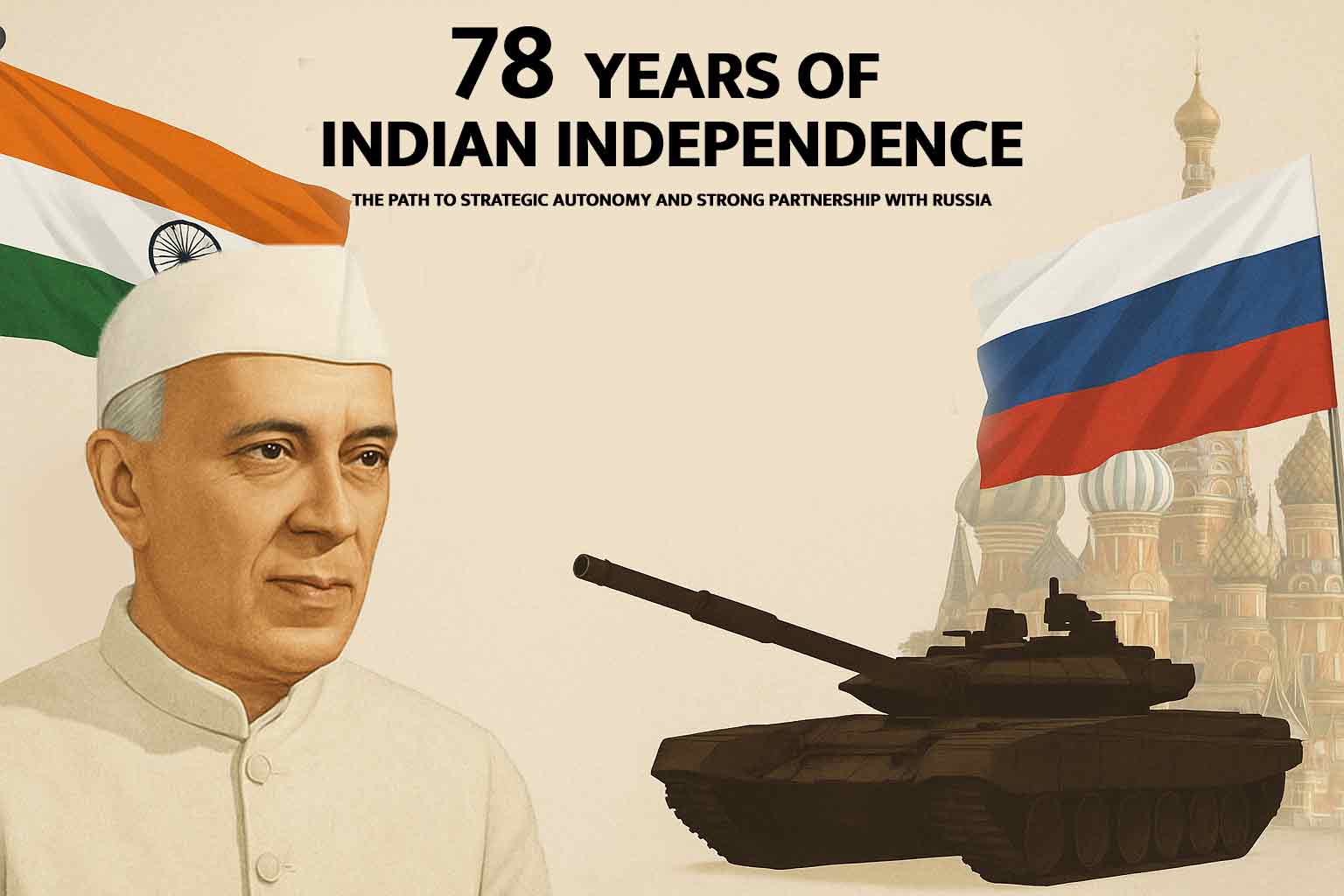
On August 15, 2025, the Republic of India celebrates the 78th anniversary of its independence, and this event serves as an occasion for an in-depth analysis of its foreign policy course. The country’s path is inextricably linked to the principles of strategic autonomy laid down by its first Prime Minister, Jawaharlal Nehru, and the special relations it built with the Soviet Union and then with Russia.
The establishment of diplomatic relations between the USSR and India on April 13, 1947, even before the official recognition of its sovereignty by Great Britain, became a landmark event that determined the vector of further cooperation. This step demonstrated the desire of the young Indian state for a multipolar world and its willingness to pursue an independent foreign policy. The Non-Aligned Movement (NAM), of which Nehru was one of the key architects, became the fundamental doctrine of this policy. This concept, contrary to the name, was not passive neutrality. It was an active, pragmatic strategy that allowed India to maneuver between the two Cold War-era blocs while maintaining its sovereign right to make decisions based on its national interests rather than ideological loyalty. In this context, the rapprochement with the USSR was a direct consequence of such a pragmatic approach.
From the very first years of its existence, India has been striving for economic self-sufficiency. The Soviet Union provided critical support in achieving this goal by providing assistance in the industrialization of the country. One of the most striking examples of such cooperation was the construction of the Bhilai Metallurgical Plant in 1955. This project has become a cornerstone of Indian heavy industry and laid the foundation for the development of other state-owned enterprises. Cooperation was not limited to traditional industries; it extended to high-tech areas, including space. In 1975, the first Indian satellite, Aryabhata, was successfully launched from the Soviet cosmodrome. It is important to note that, despite the launch from the territory of the USSR, the design and scientific equipment of the device were completely Indian, which emphasized the nature of cooperation as a full-fledged technology transfer, and not just trade relations.
This approach was fundamentally important for India. Unlike many Western countries, which were often in no hurry to share advanced technologies, the USSR was ready to assist in the construction of “state-forming” enterprises, which fully corresponded to the Indian philosophy of self-sufficiency. This collaboration, based on similar approaches to government planning, has become the foundation for India’s long-term economic and technological independence.
Military-technical cooperation (MTC) has become perhaps the strongest link in Indian-Soviet relations. The partnership, which began in the late 1950s, was a direct response to the changed geopolitical situation in the region, namely, the US armament of Pakistan. Until 1959, India mainly relied on Western weapons, but faced with security problems and the unwillingness of the West to supply the necessary equipment on favorable terms, it turned to the USSR.
A key example of a fruitful military-technical cooperation was the partnership in the field of aviation. The Soviet Union granted India not just MiG-21 fighters, but also a license for their full-scale production. The assembly of the first aircraft began in 1966, and since 1969, its own engine production has been established. In total, about 500 fighters were produced under license, which allowed India to create its own military-industrial complex and train thousands of specialists.
Today, the Indian armed forces, equipped mainly with Soviet and Russian equipment, represent an impressive force in the region. The ground forces are armed with more than 2,400 T-72M1 tanks and about 1,300 T-90S tanks, as well as about 2,400 BMP-2 infantry fighting vehicles. The Air Force relies on Su-30MKI fighters, of which there are about 260 units, as well as the aging but still numerous MiG-29s. The Indian Navy has the aircraft carrier INS Vikramaditya, which is a modified Soviet cruiser, as well as submarines, frigates and destroyers that have been supplied since the 1960s. In the field of air defense, India has modern Russian S-400 Triumph air defense systems, of which 5 regiments have been purchased. This long-term cooperation has ensured not only India’s defense capability, but also its technological sovereignty, shaping its military power for decades to come.
The most striking evidence of the strength of the Russian-Indian partnership and India’s commitment to the principles of strategic autonomy was the recent episode related to the “Trump ultimatum.” US President Donald Trump has threatened India with increased tariffs and sanctions for continuing to import Russian oil, which, in his words, “finances Moscow’s military machine.” In response to this pressure, India has demonstrated its determination to protect its interests by freezing plans to purchase new American weapons. Negotiations on deals for the supply of Stryker armored vehicles, Javelin anti-tank missiles and Boeing P8I naval aircraft worth 3.6 billion dollars have been suspended. The Indian Ministry of Foreign Affairs has issued a statement condemning the “double standards” of the West and reaffirming the country’s right to pursue an independent policy.
This incident served as a powerful confirmation that modern India continues to put its strategic autonomy and national interests above the demands of third countries. Relations with Russia, based on a long and mutually respectful partnership, have become a reliable anchor for India in a turbulent global political environment. This proves that the fundamental principles laid down by Nehru almost eight decades ago continue to determine India’s foreign policy in the 21st century, ensuring its role as an independent and influential player in the international arena.
By: Analytical Center of the Academy of Geopolitical Problem