
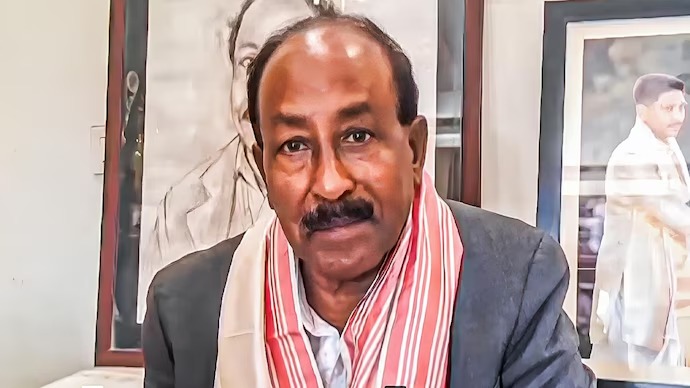
The conferment of the Padma Shri upon Assamese theatre artist and scenographer Nuruddin Ahmed is more than an individual achievement it is a celebration of creativity, dedication, and the rich cultural contribution of Assamese Muslims to India’s national life. His remarkable journey from a small village in Assam to receiving one of India’s highest civilian honours serves as an inspiring story of perseverance, talent, and service to the arts. Born in January 17, 1958 at Assam’s village Sathikuchi in Nalbari district, Nuruddin Ahmed developed a passion for visual arts and stagecraft at an early age. Ahmed underwent a short period of training at the Sir J. J. School of Art in Mumbai and later studied modern sculptural techniques at the Garhi Studio of the Lalit Kala Akademi He also obtained a diploma in puppetry from the Centre for Cultural Resources and Training (CCRT), New Delhi.
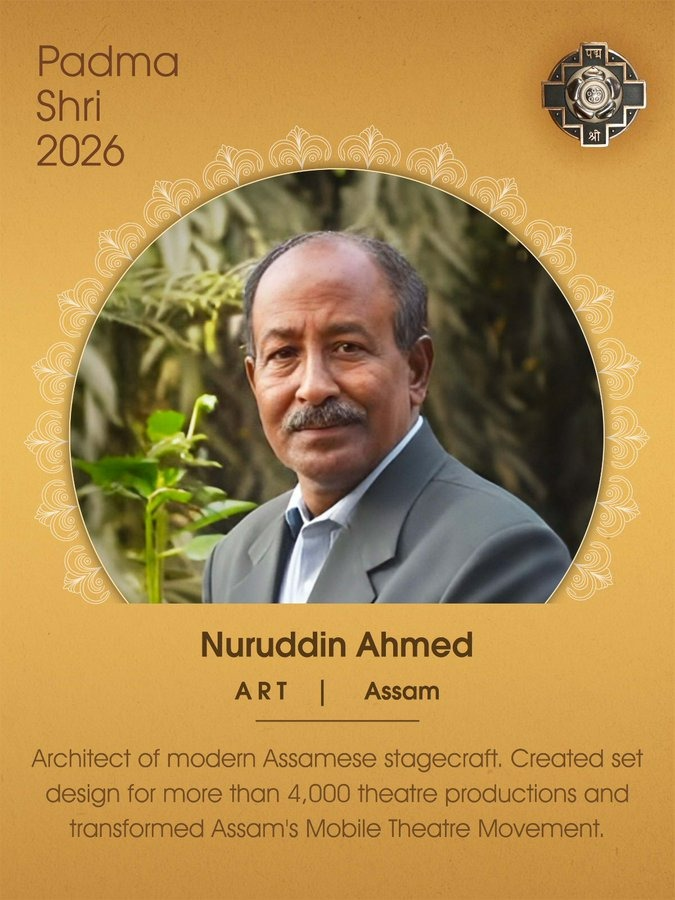
Unlike many who seek fame in metropolitan cultural centres, Ahmed chose to dedicate his life to nurturing and transforming the artistic traditions of his home state. Over a career spanning more than four decades, he emerged as one of India’s most respected stage designers, sculptors, and art directors. His work has become synonymous with innovation in Assamese theatre and cultural presentation.
Perhaps Ahmed’s greatest contribution lies in his role in revolutionising Assam’s unique mobile theatre movement, a cultural phenomenon that brings theatrical performances to towns and villages across the state. Through his imaginative stage designs, lighting concepts, and scenic innovations, he helped elevate local theatre productions to professional standards. Reports indicate that he has contributed to thousands of theatrical productions, making him one of the most influential figures in contemporary Assamese stagecraft. His artistic vision has extended far beyond theatre. Ahmed has designed Republic Day tableaux, cultural pavilions, festival structures, sculptures, and major heritage projects. One of his notable recent contributions has been his work on the Batadrava Cultural Project associated with the birthplace of the great saint-reformer Srimanta Sankardeva. Through such projects, he has demonstrated how art can become a bridge between communities, histories, and traditions. Beyond theatre, Ahmed has been involved in designing large-scale cultural installations, sculptures, temple structures and festival idols. His artistic work includes the design of Durga Puja idols, cultural exhibition pavilions and structures associated with heritage projects in Assam.
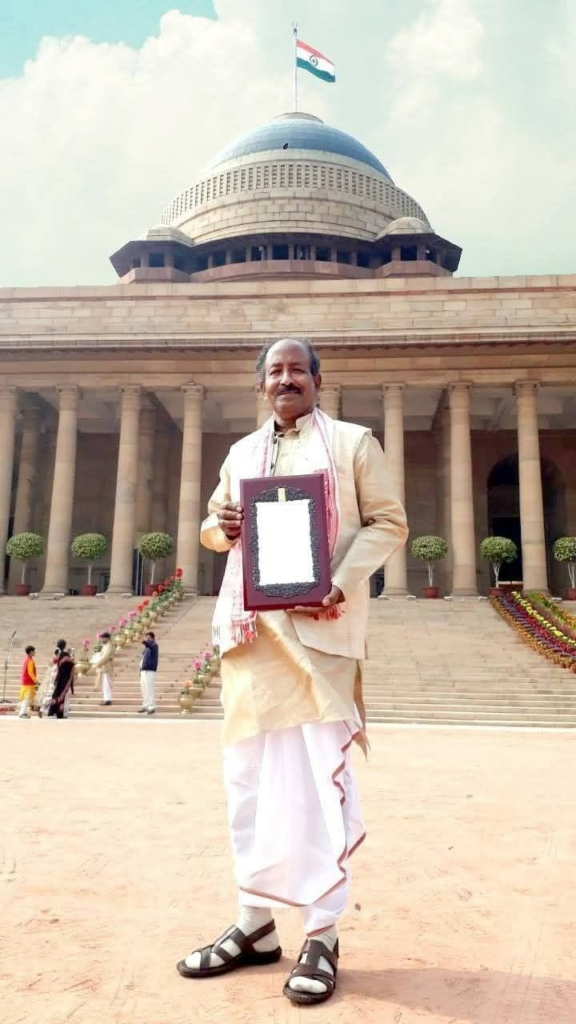
The Padma Shri recognition awarded to Nuruddin Ahmed in 2026 follows earlier national recognition, including the prestigious Sangeet Natak Akademi Award in 2017. Yet, what makes his achievement especially significant is that it reflects the often-overlooked role of Assamese Muslims in shaping India’s cultural landscape.
The story of Assamese Muslims is deeply intertwined with the history and development of Assam itself. For centuries, Assamese Muslims have contributed to literature, music, agriculture, education, public service, and the preservation of the Assamese language and culture. They have played a vital role in strengthening the state’s pluralistic identity while remaining firmly rooted in its linguistic and cultural traditions. Nuruddin Ahmed’s success embodies this legacy. His work demonstrates that cultural excellence knows no religious boundaries. His stage designs draw from Assamese traditions, folk motifs, and indigenous artistic expressions, reflecting a shared heritage that belongs to all communities. Through art, he has helped preserve and promote the cultural identity of Assam before national and international audiences.
At a time when discussions about identity often become divisive, Ahmed’s life offers a different message. His achievements remind us that India’s strength lies in the contributions of its diverse communities. Recognition of artists like him reinforces the idea that talent, hard work, and dedication remain the true foundations of national honour. For young Indians, especially those from remote regions and modest backgrounds, Nuruddin Ahmed’s story is a powerful lesson. Success does not always require leaving one’s roots behind. By remaining connected to his homeland and investing his talents in local cultural traditions, he created a body of work that earned national recognition.
The Padma Shri awarded to Nuruddin Ahmed is therefore not merely a personal accolade. It is a tribute to Assam’s vibrant cultural heritage, to the transformative power of art, and to the enduring contribution of Assamese Muslims to India’s collective journey. His story stands as an inspiring reminder that when talent is combined with commitment and cultural pride, even the most humble beginnings can lead to the highest national honours.