
SR Darapuri I.P.S.(Retd)
Anti-conversion laws, formally known as Freedom of Religion Acts, have been enacted in approximately twelve Indian states. These laws seek to regulate religious conversions by prohibiting those induced through force, fraud, or allurement. They typically mandate prior intimation to district authorities and prescribe penalties, often with enhanced punishments when the convert belongs to vulnerable groups such as women, minors, Dalits (Scheduled Castes), or Adivasis (Scheduled Tribes). While proponents present these statutes as protective measures safeguarding cultural identity and vulnerable populations from coercive missionary activities, critics contend that they curtail individual freedom, enable selective enforcement, and disproportionately harm Dalits seeking dignity and escape from caste oppression.
The stated rationale behind these laws is rooted in concerns over demographic shifts and exploitation of the socio-economically disadvantaged. Advocates, often aligned with Hindu nationalist perspectives, argue that conversions—particularly to Christianity or Islam—frequently involve material inducements, social services, or “love jihad,” targeting lower castes and tribals who are portrayed as especially susceptible. By imposing stricter penalties for conversions involving Dalits, the laws ostensibly shield them from manipulation. However, this framing reveals a paternalistic undertone: it assumes Dalits lack the agency to make informed religious choices, thereby infantilizing a community that has long fought for equality.

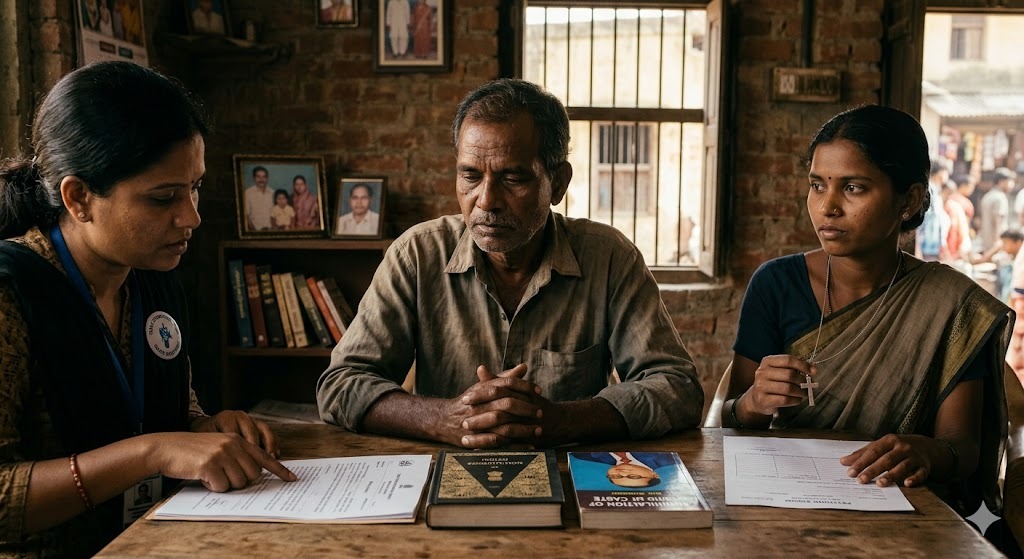
The impact on Dalits is particularly profound and multifaceted. Historically, conversion has served as a powerful tool for social mobility and resistance against caste discrimination. Dr. B.R. Ambedkar’s landmark 1956 mass conversion to Buddhism exemplified this quest for dignity free from the hierarchies of Hinduism. Similar patterns exist among those embracing Christianity or Islam in pursuit of equality. Anti-conversion laws erect administrative barriers, invite police scrutiny, and foster fear of prosecution, effectively deterring voluntary exits from the Hindu fold. This restricts a vital avenue for asserting personal autonomy in the face of persistent untouchability and social exclusion.
A more glaring inequity arises from the linkage between religious identity and affirmative action benefits. Under the 1950 Presidential Order (and subsequent amendments), Scheduled Caste reservations, protections under the SC/ST (Prevention of Atrocities) Act, and related safeguards are largely confined to Hindu, Sikh, and Buddhist Dalits. Conversion to Christianity or Islam typically results in the loss of these benefits, despite evidence that caste-based discrimination often continues irrespective of faith. Dalit Christians and Muslims have long argued that this framework is discriminatory, as it ties constitutional protections to religious affiliation rather than lived social reality. Supreme Court rulings have largely upheld this distinction, treating caste as intrinsic to Hinduism for reservation purposes while adopting a more ethno-cultural approach for Scheduled Tribes. Consequently, anti-conversion laws compound this disadvantage by raising the cost of leaving Hinduism, sometimes compelling individuals to re-convert or conceal their faith to retain reservations.
Enforcement patterns further underscore the laws’ adverse effects on Dalit communities. Reports frequently document arrests of pastors, missionaries, and community workers engaged in charitable activities—schools, health services, or prayer meetings—in Dalit-majority areas, often triggered by third-party complaints from Hindutva groups rather than the alleged victims themselves. Vague provisions such as “allurement” (which may encompass education or humanitarian aid) lend themselves to misuse, chilling social service initiatives and heightening vulnerability. While the laws claim to protect Dalits, they simultaneously limit access to services that could empower them and penalize those facilitating spiritual choices.
This is not to suggest the laws are exclusively anti-Dalit. They are primarily deployed against conversions to minority faiths, notably Christianity and Islam, and have featured prominently in cases involving interfaith marriages or alleged demographic engineering. Claims of widespread forced conversions remain contested, with empirical data often showing limited scale relative to natural population growth. Mass Buddhist conversions by Dalits, notably, frequently preserve eligibility for benefits, highlighting inconsistencies in application. Moreover, general criminal laws under the Indian Penal Code already address coercion, cheating, and fraud, raising questions about the necessity of religion-specific statutes that risk majoritarian overreach.
From a broader perspective, these laws intersect uneasily with Article 25 of the Indian Constitution, which guarantees freedom of conscience and the right to profess, practice, and propagate religion, subject to reasonable restrictions. The tension between protecting vulnerable groups and upholding individual liberty remains unresolved. Caste, as a deeply entrenched social reality, does not vanish upon conversion, yet Indian law treats it inconsistently across religions. This creates a contradictory framework: one that claims to safeguard Dalits while constraining their religious choices and material opportunities.
In conclusion, anti-conversion laws are not merely instruments targeting religious minorities; they also function as barriers to Dalit emancipation. By restricting exit options from caste-laden Hinduism, paternalistically curtailing agency, and linking affirmative action to religious fidelity, they undermine the very dignity and equality Dalits have historically sought through conversion. Genuine protection against coercion can and should be achieved through neutral criminal laws applicable equally to all, without selective burdens on propagation rights. Reforming these statutes—through clearer definitions, uniform application, and decoupling reservations from religion—would better align with constitutional values of liberty, equality, and fraternity. Ultimately, a society committed to truth and human flourishing must prioritize individual agency over majoritarian control, empowering every citizen, including Dalits, to choose their beliefs free from both coercion and state-imposed obstacles.