
by Dr Suresh Khairnar
In 1985-86, during the Shah Bano divorce case, the Supreme Court’s verdict was opposed by the Muslim communalist faction. They raised the slogan that the issue was not one of law but of faith. Under pressure from this, the then Prime Minister Shri Rajiv Gandhi overturned the Supreme Court’s decision in Parliament in favor of Shah Bano. This was compounded by his second mistake of opening the locks of the Babri Masjid, which had been locked since 1949. This emboldened the Hindutva forces. Hindu communal elements immediately seized the opportunity and, with the help of the RSS and its political wing BJP along with affiliated organizations, began organizing rath yatras (chariot processions) from Somnath to Ayodhya with full vigor. They started polarizing society communally with slogans like “The question is of faith, not law — we will build the temple exactly there.”
The RSS and VHP used Bhagalpur as a laboratory for Hindutva experiments, 13 years before Gujarat. In 1986, the Ram-Janaki Rath was supposed to come to a cowshed in Nathnagar in Bhagalpur city. However, the RSS and VHP insisted on taking it through the Muslim-majority area of Tarapur. The administration, citing law and order concerns, did not permit the procession to pass through Tarapur. This angered the RSS and VHP workers greatly.
In 1987, during Durga Puja, the immersion of idols had traditionally been done in a local pond. But the RSS formed a central puja committee and planned to take the Durga Puja idols through Tarapur for immersion in the Ganga. The administration again denied permission. Despite this, a procession was taken out late at night via the Tarapur route. No untoward incident occurred, and no action was taken against the organizers.
In April 1989, they wanted to take the Ram Navami procession through Tatarpur to Station Chowk — something that had never happened before. The Muslims of Tatarpur protested, seeing the communally charged atmosphere, and the administration also refused permission. This left the Sangh Parivar in Bhagalpur upset.
On 24 October 1989, for the rath yatra carrying bricks (for the Ram temple in Ayodhya) under the banner of “Shila Puja,” they decided — at the request of the Tatarpur police station in-charge — to start the Shila Puja procession from Tatarpur itself. Having succeeded in starting it from Tatarpur as they had long wanted, they immediately triggered riots in Tatarpur. Right after that, they sent volunteers on Hero Honda motorcycles (as mobile phones had not yet arrived) to spread two major rumors across the entire Bhagalpur commissionerate area.
Rumor No. 1: Around 400 Hindu students studying at Bhagalpur University, who were living in private hostels in Muslim neighborhoods due to lack of space in university hostels, had been brutally murdered by Muslims and their bodies thrown into the university well.
Rumor No. 2: 400 girls from Bhagalpur Women’s College had been gang-raped.
As a result, from 24 October onwards, in more than 300 villages across the Bhagalpur commissionerate, thousands of people armed with whatever weapons they could find from their homes attacked Muslim homes. They destroyed houses of Muslims who had lived there for thousands of years, burned the looms and machines of Muslim weavers (who traditionally weave silk cloth in the region), and killed more than 2,000 people — mostly from the Muslim community, including women and small children. This figure of 2,000 represents only those whose families received government compensation; many more families could not get compensation due to lack of proper documents.
This technique of spreading riots used by Hindutva forces has been described by Bhisham Sahni in his novel Tamas, based on the Partition riots in Punjab. It was later shown as a TV serial on Doordarshan in the 1990s and is still available on YouTube. The pattern of starting riots — taking processions through Muslim neighborhoods and religious sites, deliberately raising provocative slogans, playing loud music, throwing dead pigs into mosques, or splashing saffron color on mosque walls — has been documented for nearly the last 300 years in Indian riot history, as recorded by Shailesh Bandopadhyay in his original Bengali work and its Hindi and English translations. The first recorded riot in Ahmedabad dates back to 1727.
On 25 October, after reading reports in Kolkata newspapers, senior journalist of Anand Bazar Patrika and Bengali writer Gourkishor Ghosh, along with students, teachers from Visva-Bharati University in Shantiniketan, began frequently visiting Bhagalpur from the end of October. At that time, I was living in Kolkata because my wife worked in a Kendriya Vidyalaya there. Prof. Veena Alase, the head of the Marathi department at Visva-Bharati, and Gourkishor Ghosh kept updating me about the Bhagalpur riots and urged me to go there. However, our two children were small and attending school, so I was occupied with the role of a house husband.
As soon as our children and Madam Khairnar’s school summer vacations began, I left for Bhagalpur the very next day, on 6 May. Upon reaching there, we saw that many NGOs were already working on relief. We thought we were not an NGO, nor did we have the financial means to spend money on relief work. The biggest shortcoming I noticed was that while many people were engaged in relief, six months had passed since the riots, yet Hindu-Muslim interactions remained completely frozen. No Hindu would sit in a Muslim’s cycle rickshaw, nor would any Muslim sit in a Hindu’s. The same situation prevailed in the markets. This frozen state was not healthy for society. Ice had formed between the two communities.
Therefore, I suggested that our priority should be to restore normal interactions between the two communities. We decided to first establish dialogue with both sides. We began by empathetically listening to the pain of the victims, winning their trust, and simply hearing what they had gone through after 24 October 1989. This might help reduce some of the accumulated grief in their hearts.
We started visiting villages within a 50 km periphery of Bhagalpur, including areas like Yamuna Kothi in Nai Bazaar (where riots occurred), Bhataudiya, Tamauni, Chanderi, Rajpur, Babupur, Rajindipur, and around 50 other villages. We spoke with affected Muslim families and a few Dalit or backward-caste Hindu families whose houses had been destroyed.
On 7 May, in the scorching afternoon sun of May, our team was walking from Rajindipur to Babupur in Sabour block. Manisha Banerjee, a student from Shantiniketan, had lost one of her slippers, so we were moving slowly behind the others. In Babupur, a thin, frail man of about 30-35 years, wearing only a gamchha around his waist with no upper garment — looking like the living image of destitute Narayana — stopped us and asked, “Who are you people? And why have you come here?”
I said, “I have come from Kolkata, and this girl is from Shantiniketan.” He asked again, “What work brings you here?” We replied, “We have come to see the situation after the riots that followed the Shila Puja procession.”
He immediately said, “Our Ramji’s temple — the Miyan people were opposing it, so we demolished all their houses.” This conversation was happening right next to more than 30 Muslim houses that had been turned into ruins. The residents had fled to the neighboring Muslim-majority village of Rajpur and were living in makeshift grass huts.
Most houses in Babupur were made of mud, and the demolished ones were completely razed to the ground. I asked this destitute stranger, “You asked for our names and where we came from — now please tell us your name too.” He said his name was Kishan and that he worked as a barber.
By then, 15-20 men, women, and children had gathered. I asked, “How exactly did the Muslim community living in these 25-30 houses of your village oppose the Ram Mandir?” He said they had not opposed it locally; Muslims from Bhagalpur had stopped the bricks going for Ram Mandir construction. I pointed to a nearby ruined house and asked whose it was. He said it was his. I remarked, “Your walls are only mud, and the roof tiles are broken. During rains, water must leak in, and it must be very hot in summer and cold in winter, right?” He himself admitted, “That’s why I am standing outside — the May heat was unbearable.”
I continued, “The Muslims whose houses you demolished also had mud houses. You work as a barber — what did your Muslim neighbors do?” He replied that they too were laborers. I asked, “They did not stop the Shila Puja — so was it right for you to destroy their houses?” Someone in the crowd said, “No, outsiders did all this.” I had heard this “outsiders” excuse in many other places too. I did not press it further but said, “Your economic condition and that of the Muslims is similar. There was no enmity or quarrel between you. So why didn’t you stop the outside mob?”
Everyone stood silent. I told the destitute Kishan, “You don’t even have proper clothes on your body. Who knows if there is even dal-bhat for dinner in your house this evening? If, by creating so much violence for the Ram Mandir, you could get proper clothes, a pucca (concrete) house instead of this kachcha one, or a sack of dal-rice in your home — then let us all join together to build a temple so tall it reaches the sky.”
People in the crowd immediately started saying, “How is that possible?” I replied, “Then what is the point of fighting over temples and mosques instead of solving our everyday problems?” The crowd said, “Only people like you come to talk like this. Others only come to talk about temple-mosque issues. Will you people come again after this?”
After this sudden roadside conversation in the blazing May sun of Babupur, when we were returning and sitting in the night train from Bhagalpur, I was sitting on a side berth, gazing into the darkness outside. Gourkishor Ghosh asked, “Suresh, what happened? Can’t you sleep?” I said, “Yes, I am unable to sleep.” (This was the beginning of my insomnia problem.) Gourkishor Ghosh came down from his berth and sat beside me. Seeing this, Manisha also came down from the upper berth and sat between us.
Gourkishor Ghosh said, “Suresh, we are outsiders. What more can we do?” I replied, “Gourda, you are a senior journalist with Anand Bazar Patrika. You may write one or two articles. I too may write something in Marathi. But will that reduce the intensity of the Bhagalpur riots? You have seen it firsthand. You yourself experienced the Partition, leaving your ancestral home in East Bengal. How many more partitions are we going to witness with our own eyes?”
Mahatma Gandhi had left the celebrations of Independence and was running around in the mud and thorns of Kolkata and Noakhali at the age of 77 to restore peace. Lord Mountbatten told him that he alone had established peace in eastern India, while the government with 50,000 troops had failed. In Punjab and the capital of India, Delhi That is why Gandhi was called to Delhi. To stop Gandhi’s tireless efforts for peace and communal harmony, a Hindutva communal conspiracy was hatched by RSS worker Nathuram Godse and his associates, and they assassinated him.
Why can’t we try to complete the unfinished work of our ideal Mahatma Gandhi? That is why, along with Manisha Banerjee, friends from Bhagalpur’s Sangharsh Vahini, and many others like us across the country, we have been continuously working against communalism for the last 35 years.
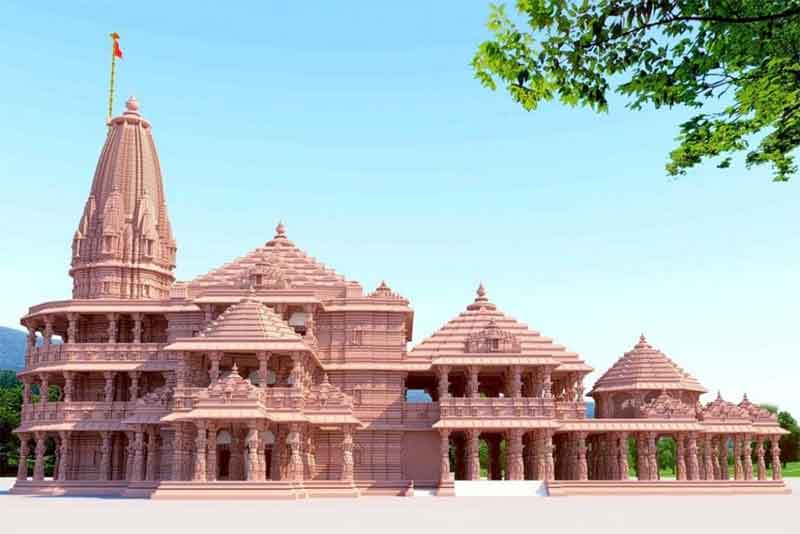
But after the “Mandir Wahi Banayenge” (We will build the temple exactly there) movement, the forces behind the Ram Mandir agitation gained power in India due to communal polarization politics and also got the temple built. Was it built only for looting and profiteering? Lakhs of people lost their lives in the name of the temple, and losses worth billions occurred separately. Yet the controversies surrounding the temple refuse to die down.
After doing all this, the RSS and its political unit BJP — from removing the debris of the Babri Masjid to build a grand Ram Lalla temple, to the land acquisition scams in Ayodhya and Faizabad, irregularities in temple construction, water leaking from the temple roof in the first rains, to the ongoing cases of theft from donations and offerings — the Ram Mandir Trust is 100% controlled by RSS people. Just as Birla temples in Delhi, Bhopal, and Kolkata are called Birla Mandirs, this Ram Lalla temple in Ayodhya is only nominally so. In reality, it stems from the demolition of the Babri Masjid. Judges were pressured to give verdicts saying “the question is of faith, not law,” even while acknowledging the criminal act of demolition. According to the Indian Constitution, with a criminal case still pending, the judges said a crime was committed but decided in favor of temple construction keeping public sentiments in mind.
Will all future decisions now be taken on this majoritarian basis? Whether it is issues of farmers, laborers, paper leaks in students’ exams, the chaos around citizenship laws, or controversies regarding the Election Commission — will our courts now decide everything based on majoritarian criteria? Some Hindutva supporters have already started arguing about the temple thefts that “this is a Hindu temple, the thief is also Hindu — no one else has the right to interfere.”
Source : Counter Currents .org