
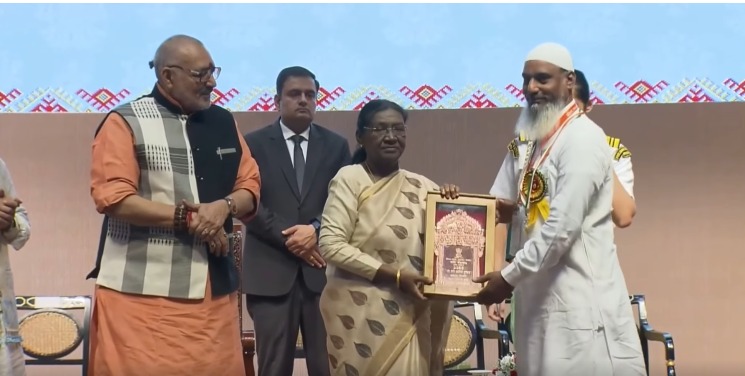
In the narrow lanes of Varanasi, where the rhythmic sound of handlooms has been part of everyday life for generations, tradition is not merely preserved it is woven, thread by thread, into the cultural fabric of India. Among the artisans carrying this remarkable legacy forward is Shah Muhammad Ansari, a distinguished Banarasi weaver from Cholapur, Varanasi, whose dedication to traditional weaving has earned him one of India’s most prestigious recognitions in the handloom sector.
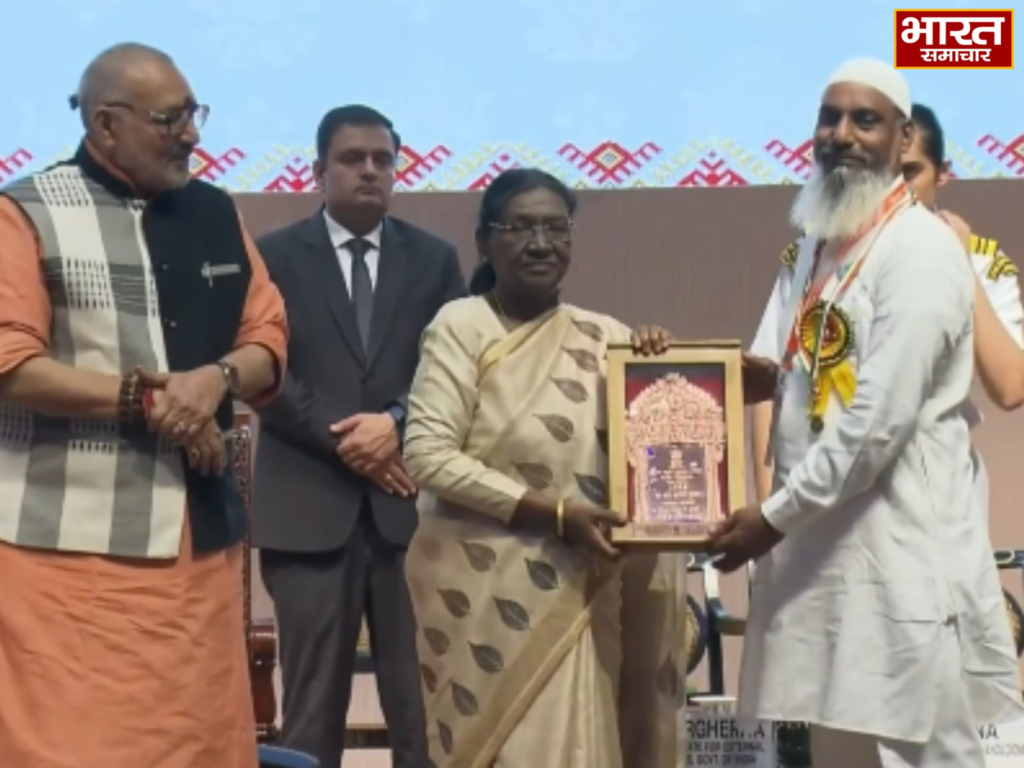
On the occasion of the 12th National Handloom Day, 7 Aug 2026, Shah Muhammad Ansari was honoured by President Smt. Droupadi Murmu in New Delhi with the Sant Kabir Handloom Award in the endangered weaving category. The recognition is a tribute not only to his individual craftsmanship but also to his contribution towards preserving weaving traditions that face the challenge of disappearing in the age of mechanisation and mass production. The Government of India’s handloom records have previously listed Shah Muhammad Ansari among the country’s National Award-winning weavers, with his address recorded in Cholapur, Varanasi. He has also been included in official artisan listings for Banaras Zardozi.
Shah Muhammad Ansari’s story represents something much larger than an individual success story. It is the story of a craftsman who chose to remain connected to an inherited skill while adapting it to contemporary demands. Traditional Banarasi weaving requires patience, precision and extraordinary attention to detail. A single piece may involve intricate motifs, zari work and techniques passed down through generations. Banaras brocades and sarees are recognised as a GI-registered product, celebrated for their finely woven silk, elaborate zari ornamentation, floral and foliate motifs, jali and meena work, and their association with the traditional Banaras handloom. For artisans like Ansari, therefore, the loom is not simply a means of livelihood. It is a repository of knowledge. His work in preserving endangered weaving traditions and training younger generations demonstrates an important principle: a heritage survives only when the next generation is given both the skills and the confidence to carry it forward.
Any serious account of the Banarasi handloom tradition is incomplete without acknowledging the enormous contribution of Muslim weavers. For centuries, Muslim julaha and Ansari families have played a central role in the weaving ecosystem of Banaras. In many parts of the city and surrounding areas, weaving skills have been transmitted from father to son, with entire families participating in different stages of production. This relationship between community and craft has produced one of India’s most recognisable cultural symbols: the Banarasi saree.
What makes the story particularly significant is that the final product represents the composite cultural character of India. The saree may carry motifs inspired by India’s diverse artistic traditions, while the craftsmanship may emerge from generations of Muslim weaving families. The result is not a symbol of one community alone—it is a manifestation of India’s shared cultural heritage. The official Varanasi district website describes silk weaving as one of the city’s premier traditional crafts and notes that Banarasi sarees are preferred not only across India but also internationally.

The contribution of Muslim artisans to Indian handloom extends far beyond Banaras. From Banarasi silk to Zardozi, embroidery, carpets, shawls and other traditional crafts, Muslim artisans have helped preserve techniques that require years of apprenticeship and extraordinary manual skill. What is particularly encouraging today is that a new generation of Muslim artisans is increasingly combining traditional craftsmanship with modern design, entrepreneurship, digital marketing and global outreach. This transition is crucial. The future of handloom cannot depend solely on nostalgia. Traditional crafts must become economically sustainable, commercially viable and attractive to younger generations. Artisans need access to better markets, design innovation, technology, finance and education.
Shah Muhammad Ansari’s example is important precisely because it connects heritage with the future. The Government of India itself recognises that handloom development requires support for raw materials, looms and accessories, design innovation, skill development, infrastructure and marketing.
India’s handloom industry is much more than an economic activity. It is a form of cultural diplomacy. When a Banarasi saree reaches London, Dubai, Paris, New York or Tokyo, it carries with it a story about India—its craftsmanship, diversity, history and civilisational continuity. The saree becomes an ambassador of Indian culture. This is where the contribution of Muslim weavers becomes especially significant. Their craftsmanship demonstrates the lived reality of India’s composite culture: communities with different religious identities have jointly shaped cultural traditions that are now recognised globally as distinctly Indian. The Banarasi saree itself carries this message beautifully. Its motifs, colours, silk, zari and weaving techniques represent centuries of cultural interaction. The hands that create it represent India’s plural social history.
Shah Muhammad Ansari’s recognition should therefore be viewed not merely as an award to an individual artisan, but as an encouragement to thousands of young people associated with India’s traditional crafts. His journey sends a powerful message: traditional skills do not have to disappear in the modern age. They can evolve, innovate and achieve national and international recognition. The challenge now is to ensure that young members of weaving communities see dignity, prosperity and opportunity in their ancestral craft. India needs more initiatives that connect traditional artisans with modern education, technology, fashion institutes, designers, e-commerce platforms and international markets. The handloom sector already supports millions of livelihoods. Government data has documented millions of handloom weavers and allied workers across India, while current government programmes continue to focus on welfare, skill development, marketing and economic support for the sector.
Shah Muhammad Ansari’s Sant Kabir Handloom Award is ultimately a celebration of a simple but profound idea: India’s heritage survives through the hands of its people. His loom connects generations. His craftsmanship connects tradition with modernity. And his achievement connects a local weaving tradition in Cholapur with the national stage in New Delhi. Most importantly, his story reminds us that the contribution of India’s Muslims to nation-building is not confined to politics, academia or business. It is also visible in the cultural and economic heritage that India presents to the world.