
President of the Academy of Geopolitical Problems Stepanyan A.O. Philosophiæ Doctor PhD
The Beginning of the path: understanding the history of mankind
Man appeared as a result of a creative act, being a free creature, similar and similar to the image of God. Despite numerous trials, wars, natural disasters, pandemics and diseases, humanity managed to recover and continued to grow in numbers. Today, the world’s population has reached eight billion people. However, the current stage of development poses a completely new challenge for us — the emergence of technologies that cast doubt on our role in the future.Рассмотрим Преимущества и Возможности Искусственного Интеллекта
Artificial intelligence (backed by human intelligence) and neural networks have become an indispensable tool of our time due to their unique capabilities for processing large amounts of information. These systems are capable of processing millions of pieces of data in fractions of seconds, identifying hidden patterns and making accurate predictions. Many people see this as a positive side: automating routine operations allows people to focus on creative and intellectually demanding tasks.Преимущества включают:
High decision-making speed: The ability to make quick and informed decisions in a time-limited environment.
Objective analysis: The absence of bias and emotion, providing a clearer and more rational approach to solving problems.
These advantages make AI a powerful ally in modern society, but an important question arises: is the assistant turning into a competitor?
The Dangers of Substitution
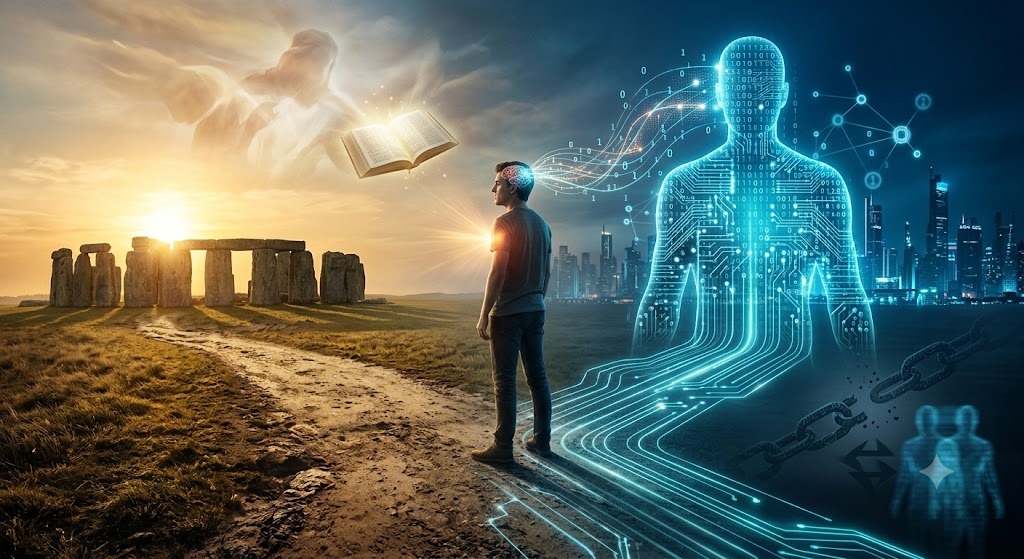
There is concern about the process of “substitution”: modern technologies are beginning to be perceived not so much as assistants, but as a substitute for people themselves. Technology tries to mimic the human experience by replacing the unique features of human existence. This process is becoming particularly alarming as the line between artificial and natural is blurring.
To understand this phenomenon, it is useful to turn to the religious heritage of mankind. In the biblical story, God’s creation of man emphasizes the importance of free will, creativity, and responsibility for one’s own actions. It is this freedom that makes a person a unique part of the universe, different from machines and algorithms. According to the Bible, God created man in his own image (Genesis 1:26-27). One of the manifestations of this image is free will. That is, a person is endowed with the ability to make decisions on their own, make choices and be responsible for their actions.
This freedom is expressed in the following:
The choice between good and evil: A person is able to choose the path of good or evil, obedience to God or self-will. Being able to make an informed choice makes a person responsible for their actions.
The ability to love and forgive: Free will allows a person to show love, patience and humility, rejecting selfishness and malice.
Creativity and initiative: A person is creatively active, using their talents and abilities, which is also the result of freedom. Thus, the statement that God created man to be free emphasizes the unique human trait that allows him to develop spiritually, make independent decisions and be responsible for his actions.
The conflict between good and evil
History shows that evil arose long before the appearance of man. Even before the creation of man, there was a rebellion of a heavenly being, Lucifer, also known as Satan. This event led to the division of the angelic community and the emergence of a conflict between the forces of light and darkness. This became the basis for the further confrontation between good and evil, expressed in the devil’s desire to sow chaos and destruction among people.
The study of sacred texts helps to better understand the nature of evil and the reasons for combating it. The main motivation of evil is pride and the desire to become equal to God. Satan and his followers, from the moment man appeared, hated him as the God of creation. According to most religious traditions, the devil does not have the ability to create life, including the creation of humans. The creation of life is the prerogative of God, the sole creator of the universe and all things. And here’s why: Creative power belongs exclusively to God: The Bible teaches that it was God who created the world and all living things (see, for example, Genesis 1:1-27). Only He has the ability to breathe life into a being and endow it with a soul.
The devil is limited by his nature: As a fallen angel, the devil has lost his original position and no longer possesses creative power. He can only distort, destroy and mislead, but not create life. He operates within the existing framework of the world created by God. To create life means to possess the power and wisdom that only God possesses. Man, created by God, is unique and bears the image of his Creator. Any attempts by the devil to imitate this process will be futile and pointless.
The practical importance of freedom of choice
Awareness of freedom of choice has a significant impact on our daily lives.
Personal responsibility: Recognizing freedom of choice obliges us to be responsible for our actions and their consequences.
Moral choice: The opportunity to freely choose between good and evil presents us with an ethical choice that determines the quality of our lives and relationships with others.
Self-development: Free choice gives us a chance to grow and develop, overcoming difficulties and improving morally.
Thus, freedom of choice is an important component of our being, influencing the formation of character, worldview and life path.
The creation of artificial intelligence is traditionally considered as a field of science and technology accessible to people due to their intellectual efforts and technological achievements. Religious concepts concerning the devil are usually limited to describing his abilities as negative influences on humanity, such as deception, destruction, and temptation. Therefore, the devil is not able to create artificial intelligence, because it requires a creative act unique to God.
Thus, despite the power and influence attributed to the devil, he is unable to create both a human and an artificial mind. This right and duty belong exclusively to God.
Numbers serve a person… or against him?
Since the devil is unable to create a human, it is assumed that he will try to use artificial intelligence and neural networks to create a pseudonymous person to replace the real person. Such an action can be interpreted as a symbol of victory over God’s intentions. Is such a development possible? This question remains open, but logic suggests that such a scenario cannot be ruled out. Some scientists warn of the risks associated with the development of AI, arguing that excessive trust in technology can lead to new forms of addiction and manipulation.
The technology was originally conceived to support and help people. The concept of numbers plays a key role in our perception of the world, as mathematics underlies many scientific discoveries. The famous Frenchman Blaise Pascal noted that “God speaks to man in the language of mathematics,” emphasizing the deep interpenetration of science and religion, testifying to the harmony of the world. Of course, the one who believes is blessed, but it seems to me that God is gradually opening up knowledge to us for scientific knowledge of God.
Thanks to technical innovations, people have mastered the ways of instant communication and information exchange using mobile phones and other gadgets. The very appearance of a mobile phone can be considered a sign of God’s wisdom, manifested through scientific discovery. I’ve always wondered how, among a billion people, He can know exactly who is asking for what in his prayers.
Consider the example of a smartphone: each person receives a unique number associated with a device that registers in his name. The phone is equipped with a camera and microphone, which allows you to collect visual and audio information transmitted to the servers. If he wants to talk to someone via any messenger, then he goes online using WIFI or some kind of operator and talks. On the other end of the phone, they know who is calling them by number and name. Everything that a person captures on their phone’s video camera or with whom they are talking is collected and stored on servers, and they can be controlled by one person who has access to your databases. Similarly, God monitors every human action without the need for technology. Because our eyes are a video camera, God sees what we see, our ears are a microphone, God hears what we say. And most importantly, our IP address, our individual number, is our DNA, which not only speaks about us, but also stores information about our ancestors. So God not only knows us, but also our ancestors. Our churches, temples or mosques are cellular operators, the airwaves that are everywhere throughout the universe, this is our wifi, and it’s free. Our brain is like RAM and a desktop, where God creates “folders”, gives a name, then launches programs there, “puts” floggers, and deletes them, after which a person makes scientific discoveries. All brilliant scientific discoveries were made by God, regardless of whether the “discoverer” was an atheist or a believer. In this example, we can see that numbers serve a person. This combination of science and faith forms a holistic picture of the perception of the role of man and God.
Considering that as long as numbers and technology work for the benefit of man, supporting his search for a higher meaning, there is a possibility that one day they may begin to compete with man. History knows that one of the root causes of Satan’s exile was his desire for self-aggrandizement. Originally created to glorify God and do His will, Satan rebelled, wanting to surpass the Lord and establish his own authority. This was vividly manifested in the ambitious intention to take the place of God and achieve supremacy over all beings.
This means that Satan can use AI and neural networks for his criminal purposes, namely Temptation and deception.:
One of the main ways the devil works is to tempt a person to commit sins. Through false promises of pleasure, wealth, or power, he tries to force a person to deviate from the path of righteousness.
Undermining spiritual power:
The Devil seeks to weaken a person’s spiritual connection with God by creating doubt, fear, and uncertainty. It can cause feelings of guilt, despair, or frustration to distract attention from faith and prayer.
The destruction of morality and values:
Through the propaganda of selfishness, greed and violence, the devil promotes the destruction of traditional moral principles and social norms. He encourages behavior that contradicts the precepts of love, compassion, and justice.
Creating conflict and discord:
Inciting hatred, envy and enmity among people is another strategy of the devil. He sows discord and conflict, contributing to the destruction of families, communities and entire nations.
And most importantly, these are our biometrics, which, along with the rest of our personal data, create our duplicate. That is, if someone with a demonic psyche takes possession of our personal data, then he will not need us, either alive or dead, he will completely manipulate our data.
Mind manipulation:
Modern technologies and mass media provide new opportunities for spreading disinformation and propaganda. The devil can use these tools to manipulate the opinion of the masses and shape public consciousness.
Given the fact that TNCs can create more advanced AI and neural networks with huge financial resources, they will therefore claim global power. And since we know about their ability to generate monstrous ideas to reduce the world’s population to one billion, about transhumanism, coronavirus, vaccinations, pandemics, etc., we can assume that these people may well direct Artificial Intelligence and neural networks against humans, that is, against God.
The modern world is characterized by a huge amount of digital data used to improve the quality of life. Smartphones, social networks and cloud services create the illusion of convenience and accessibility of information. Nevertheless, digital technologies are becoming dual tools.: They both help advance scientific research and understanding of nature, but they also pose a threat to privacy and personal freedom.
Philosophical reflections allow us to reflect on the limits of the possibilities of the digital environment. It can be assumed that the development of technology will reach a point where it will be tempting to entrust the most important processes to algorithms and machines. Then there is a threat of losing one’s own autonomy and turning a person into an appendage of technological infrastructure.
What lies ahead?
The question facing modern society is how to define the boundaries between support and replacement. Modern scientific achievements require a careful approach and a critical awareness of the risks. People should be aware of their unique value and independence from technological tools, while maintaining control over their own destinies.
Conclusion: Today, humanity is facing a challenge related to artificial intelligence and neural networks. These technologies hold great promise, but they also pose dangers. They are about who will stand behind the AI and what kind of morality or psyche it will have.
To avoid the tragedies of the past, it is important to remember the fundamental foundations of humanity — freedom of choice, creativity and responsibility. We have to pass a test worthy of the children of God: save our own face and not let technology erase the lines between the real and the fake.
It is necessary to strive for harmonious coexistence with technology, taking precautions and actively participating in the formation of ethics and standards for the use of new developments. Only in this way will humanity be able to preserve its freedom and dignity in the era of digitalization and artificial intelligence.