
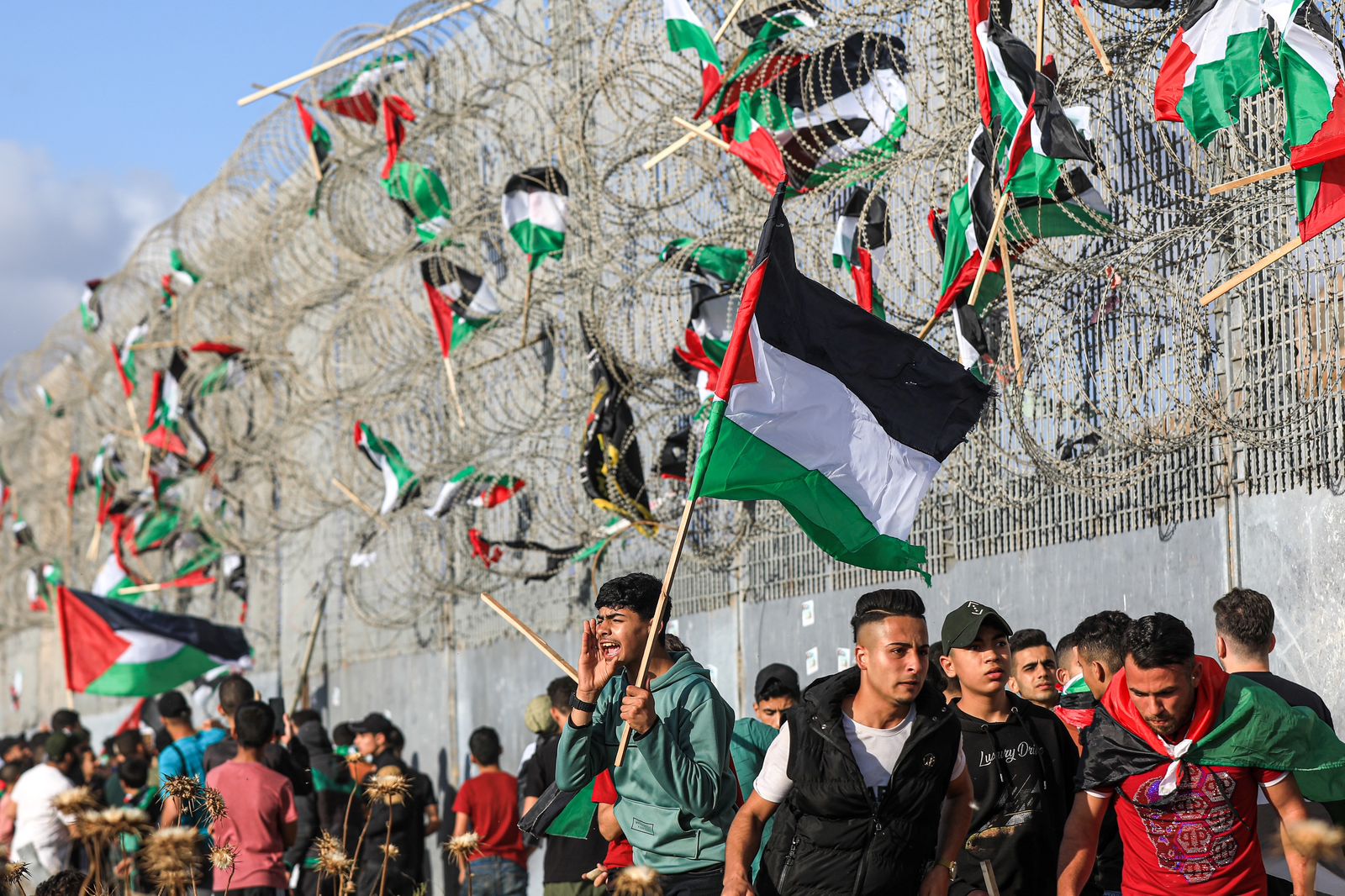
OCCUPIED JERUSALEM, (PIC)
The occupation is not measured by military checkpoints alone, nor only by the number of houses demolished or lands confiscated. For when a Palestinian is prevented from naming his city as he knows it, or is asked to treat his family history as a marginal tale, the struggle becomes over meaning itself. Palestinian identity under occupation is not a cultural slogan raised on occasions, but an act of daily survival in the face of a project that seeks to uproot the people from their land, their narrative, and their image of themselves.
From the besieged Gaza to the diaspora camps, and from the alleys of the Old City of Jerusalem to the West Bank villages threatened by settlement expansion, Palestinian identity is formed from a collective experience in which memory is inseparable from politics. It is the identity of a people who know that defending the name, the house, the dialect, the dress, the key, and the olive tree is a defense of their inherent right to freedom and self-determination.
Palestinian identity under occupation is not a matter of folklore
The colonial discourse attempts to reduce identity to heritage manifestations that can be displayed and then separated from their owners. Embroidery, food, and music are sometimes celebrated as abstract cultural elements, while the context that produced them is ignored: land that was plundered, villages whose people were displaced, cities upon which division and isolation were imposed, and a people who still live the effects of the continuous Nakba. For this reason, the Keffiyeh, Dabke, or Palestinian cuisine cannot be treated as cultural ornaments.
The Keffiyeh is linked to the history of popular resistance, embroidery carries geographical and social maps of Palestinian cities and villages, and local foods reflect the people’s relationship with agricultural seasons and their land. When these symbols are attributed to a colonial narrative that denies their owners, confronting cultural theft becomes part of confronting the theft of land. However, reducing identity to heritage alone carries another danger. Identity is not a static museum or nostalgia for a closed past. It is the ability of Palestinians to renew tools of expression without abandoning the core of the cause. It appears in the folk song just as it appears in the documentary film, and in grandmothers’ tales just as it appears in digital content that documents the names of martyrs, destroyed neighborhoods, and displaced villages.
The name and the narrative in the face of Judaization
The occupation policies target both geography and language together. Changing place names, cementing Hebrew names on maps and signs, and isolating Palestinian communities are not neutral administrative procedures. It is an attempt to produce a reality in which the Palestinian appears as a stranger to their city, and the land appears to have no history prior to the occupation.
Jerusalem presents the clearest example. The city, which forms a spiritual and national center for Palestinians, is subjected to continuous Judaization policies that include tightening restrictions on residents, confiscating real estate, and tightening control over the spatial, educational, and cultural landscape. When a Jerusalemite clings to the name of his neighborhood, documents the ownership of his house, or tells his children the history of Damascus Gate, Silwan, and Sheikh Jarrah, he is not merely exercising nostalgia, but rather thwarting a deliberate erasure attempt. The Palestinian narrative, in turn, is not a secondary matter in the face of the military and political narrative of the occupation. It is a record of facts that the occupation attempts to obliterate: the Nakba, displacement, massacres, captivity, siege, settlement, and resistance. Without this narrative, it is easy to transform the Palestinian into a figure in news broadcasts, instead of a human being with a history, rights, a name, a family, and a stolen future.
Memory is not a substitute for political action
Clinging to memory is a necessity, but it is not enough on its own. Memory may turn into an isolated emotional discourse if it is not linked to clear political and legal rights: ending the occupation, stopping settlement, the right of return, protecting Jerusalem and Al-Aqsa, and ensuring freedom for prisoners. The strength of memory is that it prevents normalization with injustice, but its strength is completed when it turns into an organized awareness and a constant demand for rights.
Furthermore, defending the narrative does not mean freezing Palestinian society within a single image. The Palestinian in Gaza, the West Bank, Jerusalem, the occupied interior, the camps, and the diaspora lives under different conditions, but the difference in experience does not negate the unity of the people. The challenge is to preserve this unity without denying the specificity of each community and what it faces in terms of oppression, siege, discrimination, or displacement.
Language and education: A daily arena of steadfastness
In the home, school, and street, the battle for identity continues in quiet but profound forms. The Arabic language is not just a means of communication, but a vessel for names, proverbs, tales, and concepts that preserve the connection of generations to their place. When educational curricula are subjected to restriction or distortion, or when Palestinian cultural institutions are pressured, the occupation targets the capacity to produce an independent national awareness.
Palestinian education is not neutral in the face of the reality of occupation, because the students do not study in a vacuum. They may cross a checkpoint to reach their school, see a raid near their neighborhood, lose a relative in an aggression, or live under the threat of demolition and displacement. Therefore, their right to an education that tells the history of their people and preserves their language and dignity is part of their right to safety and freedom. The family bears an irreplaceable role. Old documents, photographs of villages, house keys, relatives’ names, and stories of displacement are not simple domestic details. They are a popular archive that refuses to leave history in the hands of those who falsify it. However, transmitting memory requires honesty and accuracy, not the repetition of stories without documentation. Documented information protects the narrative from skepticism, and gives generations stronger tools to defend it.
The Palestinian between oppression and determination
The occupation does not stop at restricting movement, but seeks to manage Palestinian life in its finest details: permits, checkpoints, arrests, closures, siege, house demolitions, and land confiscation. These tools create constant pressure on the individual and the family, sometimes pushing toward the feeling that temporary life is destiny. But Palestinians have confronted this pressure in multiple ways. Clinging to agriculture in threatened land, rebuilding what the aggression destroyed, establishing educational and cultural initiatives, supporting the families of prisoners and martyrs, and documenting violations are all practices confirming that the people are not a subject of colonial policies, but an actor possessing will and vision.
This reality should not be romanticized or treated as an abstract story of heroism. Steadfastness is costly, and people need protection as well as political, economic, and psychological support, not to be asked to endure endlessly. The solidarity of communities, the support of local institutions, and the expansion of professional coverage that conveys the voice of Palestinians are factors that help transform solidarity from a passing emotion into a real capacity for steadfastness.
Media and the battle of the image
Much of the international coverage begins from the angle of the occupation’s security and ends there, so the roots of the story disappear and the Palestinian is often presented as a reaction, not a people living under colonization. For this reason, the importance of Palestinian media emerges, capable of calling things by their names: occupation is occupation, settlement is a crime, siege is collective punishment, and displacement is not a voluntary population transfer.
Defending identity in the media does not mean abandoning professionalism, but rather demands it more. Figures and names must be verified, survivors’ testimonies preserved, historical context shown, and the language of the occupation must not be left to define the vocabulary of discussion. Every documented image, every accurate testimony, and every report that returns the Palestinian human being to the center of the tale confronts the denial machine operating around the clock. The responsibility increases in the digital space, where truncated clips and misleading information spread quickly. Sharing angry content may seem like a natural response, but it may serve misinformation if source and context are absent.
Digital awareness here is part of protecting the cause: documentation, verification, archiving, and conscious publishing that does not grant opponents of truth easy loopholes. Palestinian identity does not wait for recognition from the occupation to be a reality. It is present in those who insist on staying in their homes, in those who preserve the name of their village in exile, in a child who learns that Jerusalem is not passing news, and in every voice that refuses to have Palestine narrated by the tongue of those who occupied it.
When people preserve the names of their places, their stories, and their rights, they leave to future generations something far beyond memory: a clear map of the path toward freedom.
Source : The palastine information center