
by Bharat Dogra
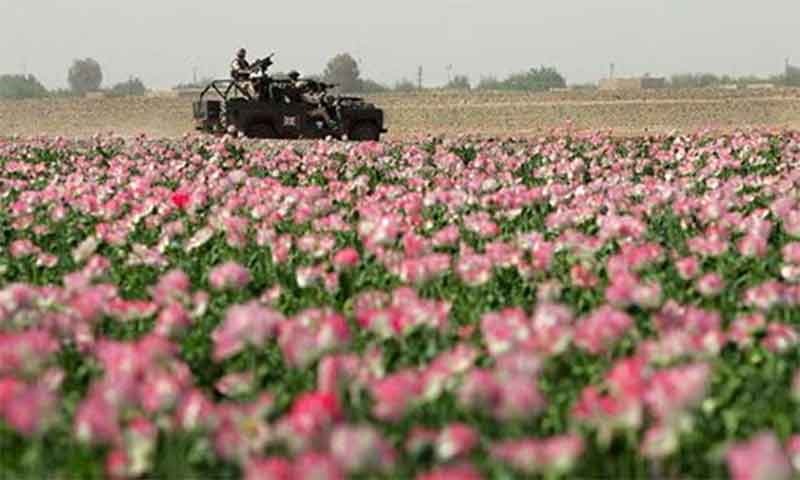
In year 2010 the area under poppy opium cultivation in Afghanistan was very high at 122,513 hectares. By year 2020 this had increased further to 223,696 hectares. During this period the peak was reached at 328,308 hectares in 2017. There were ups and downs from year to year but all along during this decade 2010-2020 the opium poppy cultivation area in Afghanistan remained at a very high level. The production of the opium crop in Afghanistan was 3576 tons in 2010. By 2020 this had increased to 6270 tons. There was a peak production of 8984 tons in 2017.
This was the period when the USA and allied forces were the most powerful forces in Afghanistan and US supported governments were in control in the country. The cultivation data is from the UN Office on Drugs and Crime (UNODC) and UN Drug Monitoring Platform.
A big question here is—as the USA with its War on Drugs has always stated that checking illicit supply of drugs, particularly heroin is a big priority for it, and as most of this illegal cultivation of opium was being used for processing into heroin, why did not the USA make it a top priority to curb illegal cultivation of opium poppy here, particularly when US funds could also have been available for compensating farmers to give up poppy opium and attract them towards cultivation of food crops or safe cash crops?
In 2021 the US forces left Afghanistan and soon the Taliban government came in. In 2022 this new government announced a ban on poppy cultivation and all types of narcotics. Within a year or two opium cultivation area declined by 90% or more. Whereas the area under cultivation of opium poppy was 223,696 hectares in 2020, this had declined to 12,800 hectares in 2024 and 10,200 hectares in 2025, according to UN data. The production of opium crop was reduced from 6270 tons in 2020 to just 296 tons in 2025.
Now all along the Taliban government has faced severe shortage of funds and so did not have the funds to compensate farmers and for other expenses but it could still achieve this. So why the USA with all its huge funds could not achieve the same in times of friendly governments when US and allied forces were also in the country (during 2002-2020)?
Anyway, once the Taliban government has achieved this, should there not be adequate appreciation for this? The least that the USA and allies can do is to release seized or frozen funds of Afghanistan so that the government here has funds to reduce the acute humanitarian crisis existing here, accentuated by the deportation of millions of Afghans earlier residing abroad. If the USA can spend billions on its War on Drugs, can it at the very least not restore to the Afghanistan government its own funds for meeting urgent humanitarian needs, also expressing appreciation of the work done by the Afghanistan government for reducing opium cultivation in a big way.
UN officials in Afghanistan (or dealing with Afghanistan affairs) have been recently emphasizing the need for increasing humanitarian assistance on urgent basis, keeping in view also adverse weather conditions that have imposed additional burden on farmers. UN officials have also emphasized that to sustain the gains of farmers giving up poppy opium cultivation, help for them is needed. Farmers who give up poppy opium cultivation incur economic loss, and as they move to food or normal cash crops, they need help, particularly in adverse weather conditions. UN officials while emphasizing this have also stated that when such help is non-existent, then sometimes examples of farmers moving back to poppy opium cultivation can be seen. Hence now is the time to sustain the move away from poppy opium by helping farmers. However this essential responsibility is being ignored by the west.
We should also revisit what happened over two decades back. In year 1999 the opium cultivation in Afghanistan had extended to 91,000 hectares. After this the newly formed Taliban government took strong steps to curb this and in year 2001 this had come down to just 8000 hectares. However later in this year the US attacked Afghanistan and the Taliban government was removed, while a government supported by the USA came in. In 2002 the poppy opium cultivation again increased to 74,000 hectares, while in 2004 this increased to 131,000 hectares. Those following the changes closely were not surprised as they had noted that while preparing to invade the US authorities had re-established their earlier contacts with powerful opium promoters—in fact in some cases even close relatives of the new ruling elite brought in by the USA were involved with opium and drugs.
In fact we should go back still more for a more complete understanding of this. During the 1970s the production of poppy opium in Afghanistan was about 100 tons annually. However a big increase took place during the 1980s as the USA with the help of Pakistan supported several Afghanistan warlords, including those involved with drugs and opium, to fight against the Soviet army and the Afghan government supported by the Soviet Union. Apart from getting CIA arms and funds, these warlords also generated huge funds from opium and drugs trade, leading to a big increase in opium cultivation.
In fact in their strongholds, some of these warlords even forced many farmers to resort to cultivating poppy opium even when they did not want to do so, using threats and violence. Historian Alfred Mccoy has stated “caravans carrying CIA arms into that region for resistance often returned to Pakistan loaded down with opium.” The Washington Times reported in May 1990 that the US government had over several years been receiving reports of heroin trafficking by some of its allies, but chose not to investigate. This neglect continued even as Afghanistan’s opium became the main sources for illicit drugs supplied to the west, generating huge illegal profits for powerful traffickers.
At the same time there were reports of the USA encouraging drug smuggling to the Soviet Union and Iran to weaken their societies. The overall result was that opium production which had averaged around 100 tons annually in Afghanistan during the 1970 had increased about 20 times to around 2000 tons in 1991. Following the withdrawal of the Soviet Army there was increasing fighting among the various warlords for gaining more control and they financed their operations by further increasing poppy opium cultivation in the areas controlled by them.
Thus it is clear that narrow and selfish considerations on the part of the west have repeatedly been leading to very serious aggravation of health and social disasters. It is time to make amends for this by contributing in a positive way now for reducing serious problems.
Credit : countercurrents