
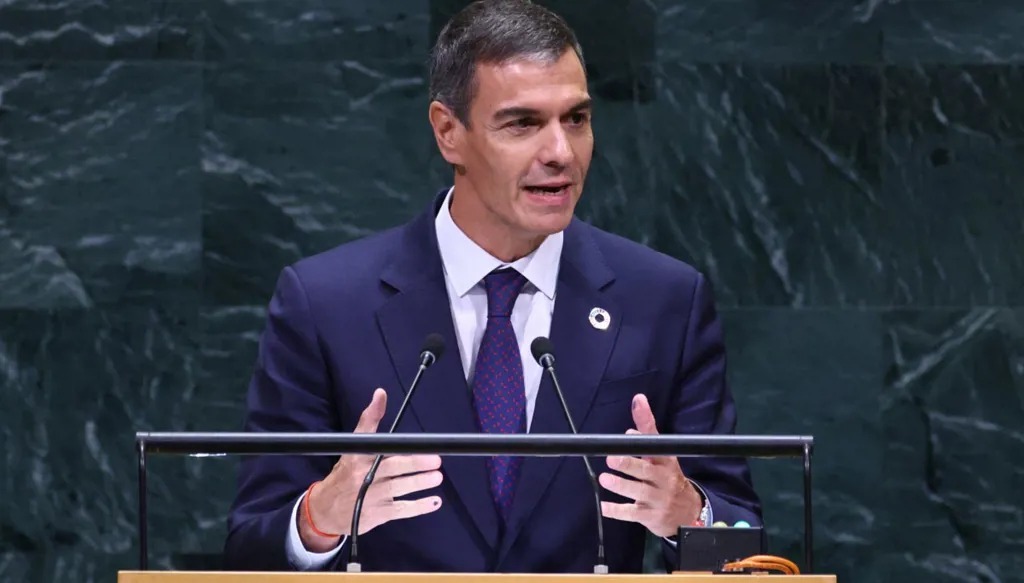
NEW YORK. Spanish Prime Minister Pedro Sánchez launched a strong criticism of Israel’s military campaign in Gaza while addressing the 81st session of the United Nations General Assembly in New York, accusing the government of Israeli Prime Minister Benjamin Netanyahu of continuing what Sánchez described as “genocide” in the territory. Sánchez said his government “unreservedly condemns” the ongoing situation in Gaza and urged the international community to avoid what he described as double standards in responding to wars and humanitarian crises.
The Spanish prime minister also warned against attempts to undermine the United Nations and the broader multilateral system. He called for respect for international law, support for international judicial institutions and accountability for those responsible for alleged violations.
Spain’s Growing Criticism of Israel
Sánchez’s remarks are part of Spain’s broader policy shift on the Gaza war. In May 2024, Spain formally recognized the State of Palestine, alongside Ireland and Norway.
Madrid has subsequently taken measures restricting aspects of its military relationship with Israel and has advocated within the European Union for a review of relations with Tel Aviv over the situation in Gaza.
Gaza Debate Intensifies at UN
Sánchez’s comments came as criticism of Israel featured prominently in speeches at the UN General Assembly, with several world leaders focusing on the humanitarian crisis in Gaza and the broader Israeli-Palestinian conflict.
Turkish President Recep Tayyip Erdoğan accused Israel of having a “genocidal mentality,” while UN Secretary-General António Guterres expressed grave concern over the scale of death and destruction in Gaza, drawing on his years of humanitarian experience.
Brazilian President Luiz Inácio Lula da Silva also accused Netanyahu’s government of genocide in Gaza. French President Emmanuel Macron, meanwhile, addressed the humanitarian situation in Gaza as well as Israeli policies in the occupied West Bank.
The statements reflect the continuing international debate over the Gaza war, the humanitarian situation in the Palestinian territories, the future of the Palestinian question and mechanisms for international accountability.