
by Ayush Mazumdar
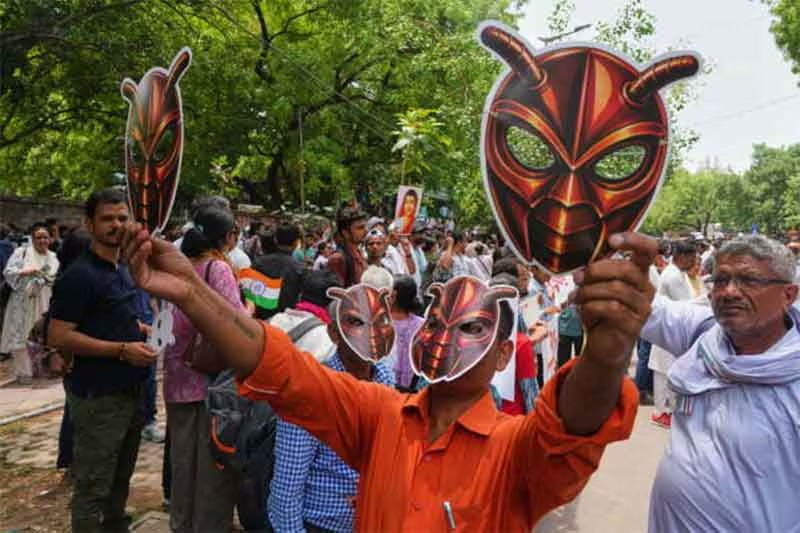
The Indian political scenario witnessed a moment of awe and wonder when the Cockroach Janata Party was able to unnerve the government of India and the ruling alliance, the NDA, into submission by successfully navigating a movement of ‘Gen Z’ over the NEET Paper leak and getting the then Education Minister Dharmendra Pradhan to resign. The protest lasted for about seven weeks at the Jantar Mantar from 6th June to 25th July 2026, but its reverberations were felt throughout the nation. The demographic profile of the protesters adds to its nomenclature, as the crowd composition consisted of young adults[1]. Before this movement, political strategists treated this digital-first generation as an apolitical demographic primarily engaged on platforms like Instagram.
A vast portion of the protestors consisted of graduates and college students. One of the notable features of this movement was the cross-caste and cross-class coalition, which, though temporary, posed a unique intersectional alliance. Many political commentators on the aftermath highlighted that Gen Z is not attracted to mainstream politics and that there is an eclipse of ideological politics, but such arguments are naïve when seen in the context of the ongoing CJP stance on the issues of the incumbent CECs’ handling of the SIR Process and the alleged irregularities in it brought to light by the Indian Express report, which pointed out the ignored internal dissent within the ECI [2]. Similarly, activist Sonam Wangchuk voiced his support for the CJPs’ call for electoral transparency [3]. Following the expiry of the ultimatum, the CJP called for a nationwide campaign starting from 2nd October 2026 – the Birth Anniversary of Mahatma Gandhi.
Mainstream Indian politics has always been centred on constitutional morality and the framework drawn by it. The Modern Indian nation-state derives its powers from the Indian Constitution, which came into force on 26th January 1950, but the challenges, objectives and the citizenry the Indian state was tasked to address go long before 1950. While post-colonial scholarship tries to redraw the boundaries of colonial legacy, that framing presupposes a pre-colonial reality against which the colonial period is measured and made meaningful. Hence, the modern Indian nation-state is an evolutionary product standing at a historical crossroads. The state itself is a political phenomenon that shapes the lived reality of its citizens. Hence, it is always in a state of flux, drawing and redrawing its role with time, taking cues from the system analysis framework put in place by David Easton.
The state, as a system, responds to and feeds back into its environment. To speculate that the CJP movement occupies a space outside the mainstream politics is to misread the socio-political trajectory because the electorate articulates their issues through the CJP platform, from which the state derives its electoral mandate and legitimacy. The state without its citizenry is without the constitutional base. Contemporary mainstream politics goes hand in hand with the ideological fault lines of the Indian socio-political spectrum. The constitutional bedrock of Indian democratic politics centres on the electoral factor, which provides the numerous disparate groups with a legitimate claim to public policy. Hence, the CJP calling for the resignation or stepping down of the CEC doesn’t vitiate the effectiveness of the ECI in the democratic framework but justifies its role in ensuring a free and fair election; the CJP seeks reform. To label the CJP as anti-institutions is problematic on that front, as the CJP seeks a fair establishment to ensure just elections coterminous with the constitutional philosophy of a just democratic republic.
For instance, the Anna Hazare-led Indian anti-corruption movement in 2011 has played an important role in shaping the post-2014 electoral politics in India, with a civil society mobilisation feeding directly into the formation of the Aam Aadmi Party. In mainstream Indian politics, pressure-group politics of this kind has historically functioned as a route into mainstream party formation, not evidence of retreat from it. To read the CJP’s refusal to constitute itself as a party as disengagement from party politics is, on this precedent, premature rather than definitive. This strikes at the heart of Indian politics.
To argue that Gen Z has lost trust in the institutions is a misnomer because the CJP has been rallying and pleading in front of the Supreme Court to direct the state to withdraw the FIRs registered in the aftermath of the NEET paper leak protest [4]. It believes in the system but wants it to be used fairly for the purpose it was established. Hence, it is not post-ideological politics that the CJP stands for but one of constitutional morality. It takes us back to the dramatic moment when Abhijeet Dipke came out of the airport holding a copy of a book titled ‘My Autobiography’ with the picture of Dr B.R. Ambedkar on it– the Chairman of the drafting committee of the Constitution of India. Just like taxation has often been argued to be the glue that binds the citizens with the state, in the contemporary context, elections are the glue that binds the republic to its citizenry. Elections are the fundamental process that shapes the substantive character of the democracy.
Source : countercurrents.org