
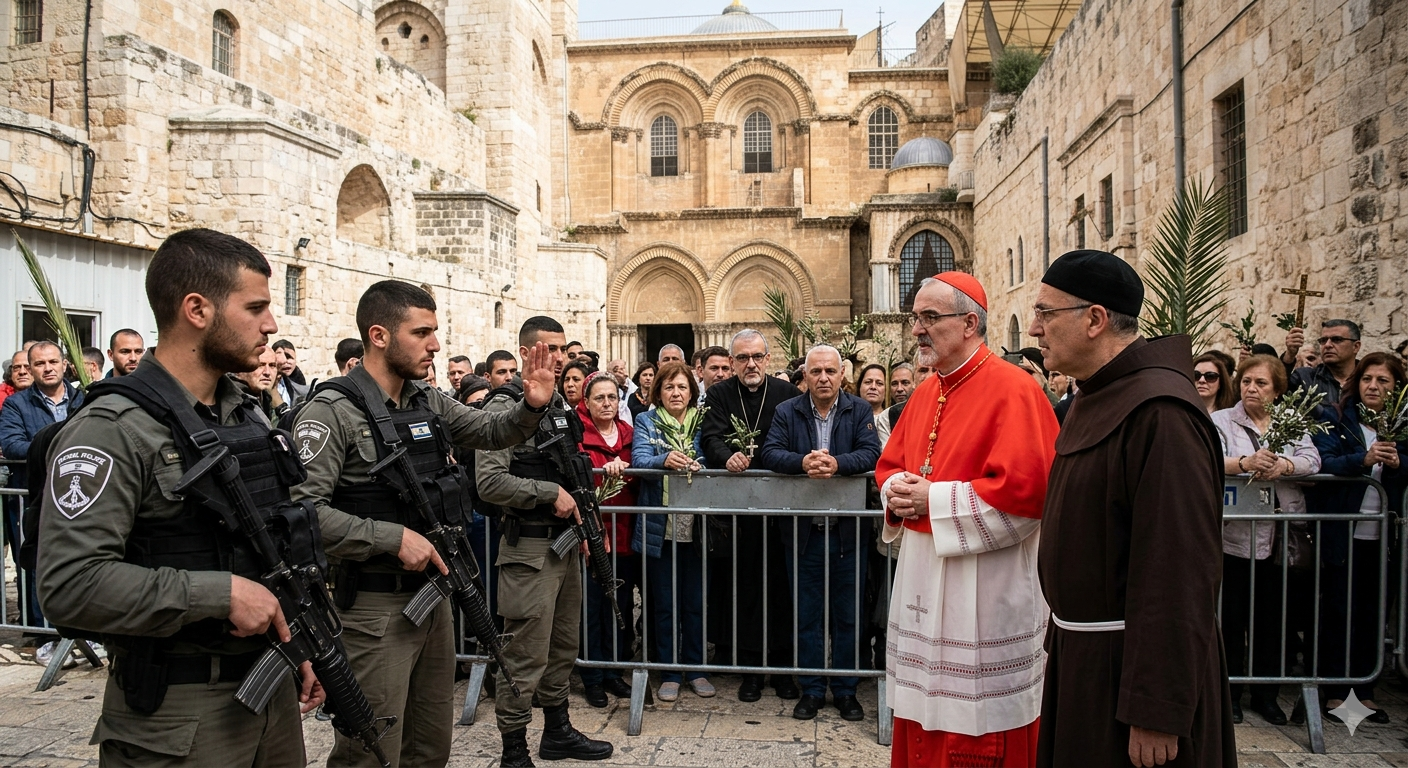
Jerusalem, which has been a center of faith and worship for centuries, witnessed a shocking controversy this time on Palm Sunday. According to the Jerusalem Governorate, the Israeli Occupation Authority (IOA) prevented the traditional mass from being held at the Church of the Holy Sepulchre. This is being described as a direct attack on religious freedom.
The Governorate says that Latin Patriarch Cardinal Pierbattista Pizzaballa and the Custos of the Holy Land, Father Francesco Ielpo, were not even allowed to reach the church. This raises the question: has worship in Jerusalem now become dependent on “permission”?
The Governorate has described this action as a “blatant violation” of international law and humanitarian principles. According to them, it not only goes against the historic rights of unhindered access to religious sites, but also sends a dangerous signal that the status of holy places is being altered.
The Governorate stated clearly that Israel has no sovereign authority over occupied Jerusalem and its Islamic and Christian holy sites. Despite this, if access to worship is being blocked, it appears to be not just an administrative decision, but part of a deliberate policy.
The statement also alleged that this step reflects a “systematic policy” aimed at undermining religious freedom and establishing control over the management of holy sites. What is more concerning is that both Islamic and Christian sites are being targeted simultaneously.
The Jerusalem Governorate made a strong appeal to the international community, saying that now is the time not for “silence,” but for concrete action to prevent such incidents and to ensure freedom of worship for all.
In the end, a clear message was given: the identity of Jerusalem, its faith, and its history cannot be changed by any pressure or restrictions. The question now is whether the world will hear this call, or whether these constraints on faith will continue unabated.