
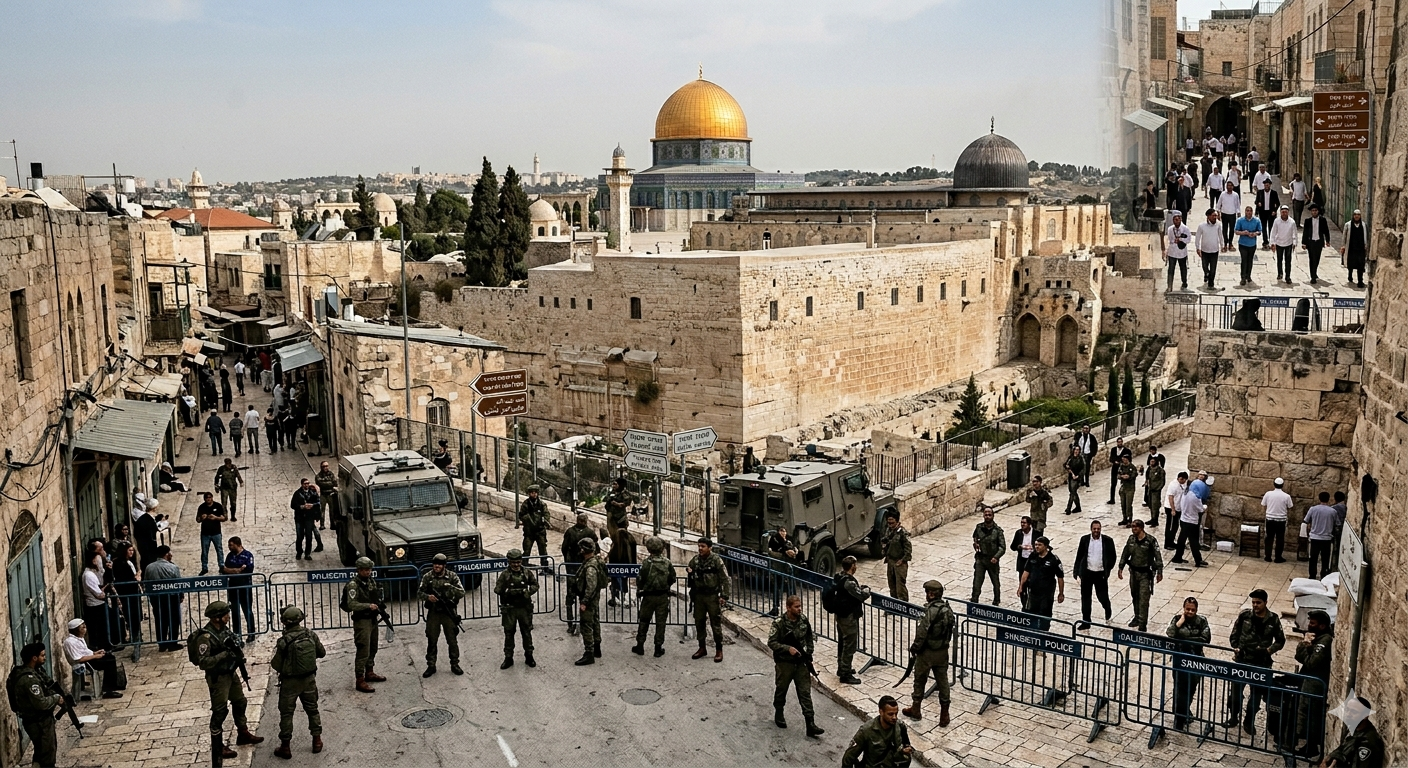
In occupied Jerusalem, the situation no longer appears limited to just “security,” but rather an open struggle over both land and identity. Al-Aqsa Mosque has remained closed for 32 consecutive days. Worshippers have been completely barred from entering — a move being described as the longest restriction in decades.
This tightening has increased at a time when Passover is approaching. Heavy security deployment in the Old City, checkpoints, and restricted movement together are creating an atmosphere where control seems more visible than worship.
Meanwhile, settlers performing Talmudic rituals at the Bab al-Rahma Cemetery—that too under heavy security—are further deepening tensions. The question now arises: are these merely religious activities, or part of a larger shift?
According to reports, some temple-supporting groups are attempting to revive ancient rituals such as “Passover sacrifices” within the mosque compound. Financial incentives are even being offered for this. In other words, faith now appears to be not just a matter of belief, but part of a carefully planned strategy.
In addition, the issue of the “Red Heifers” has suddenly gained momentum. Some groups link it to the construction of a temple and consider special ritual purification essential for it. The growing activities around the breeding and care of these cows in recent months point in that direction.
And it’s important to note that it’s not just Al-Aqsa— the Church of the Holy Sepulcher is also closed. This means the impact is not limited to one religion; rather, the entire religious landscape is under pressure.
Israeli police have indicated that these restrictions may continue until mid-April. Local organizations see this as part of a broader process of change, where both control and the overall character are gradually being reshaped.
Most importantly, even during Ramadan, Palestinians were prevented from offering prayers at Al-Aqsa—so much so that even Eid al-Fitr prayers could not take place. This is not just an administrative decision, but a signal pointing toward the direction of what may lie ahead.
In Jerusalem, the issue is no longer just about security—the real question now is whether the city’s identity is gradually being reshaped into a new mold.