
By – Divya Pandey
The recent exchange involving Norwegian journalists and Prime Minister Narendra Modi during his visit to Oslo was not merely an awkward diplomatic episode. It reflected a deeper and increasingly visible clash between two competing political cultures: the Western expectation of adversarial public accountability and India’s carefully managed model of political communication.
For years, New Delhi has dismissed Western criticism on press freedom as selective lecturing by countries that often weaponize liberal values while ignoring their own contradictions. There is some truth in that argument. European states routinely invoke democratic ideals abroad while remaining strategically flexible when economic or geopolitical interests demand it. Yet reducing the Norway episode to mere Western hypocrisy would be intellectually dishonest and strategically shortsighted.
The uncomfortable reality is that India’s communication model under Prime Minister Modi has become extraordinarily centralized, disciplined and insulated from unscripted scrutiny. The absence of open press conferences, limited exposure to difficult questioning and the preference for controlled messaging have increasingly become defining features of governance. This may be politically effective domestically, but internationally it creates an image problem that India’s diplomats can no longer easily neutralize.
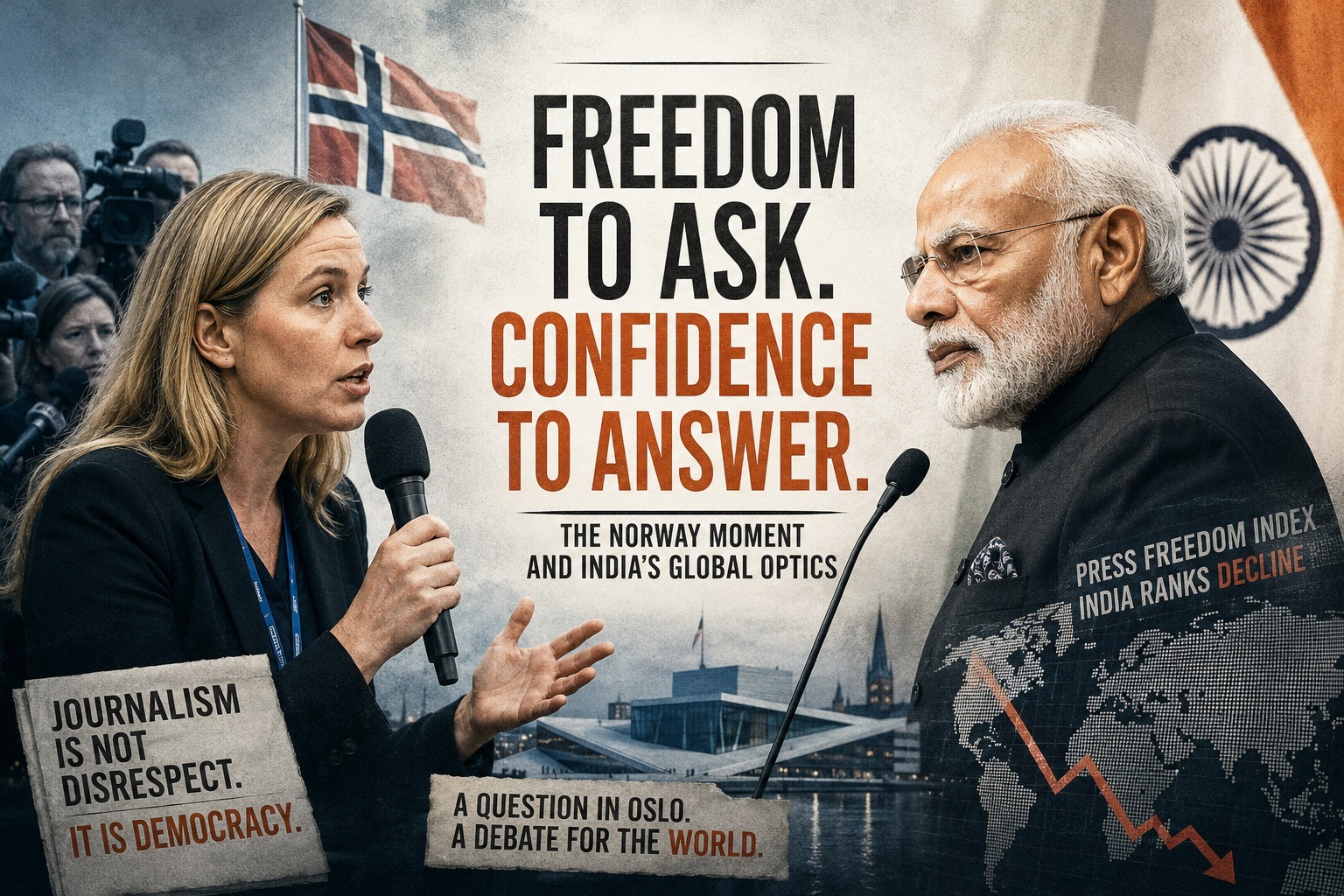
The confrontation in Oslo exposed this tension in full public view. Norwegian journalist Helle Lyng Svendsen openly questioned why the leader of the world’s largest democracy avoids unscripted media interactions. The moment quickly became symbolic because it touched a global debate already surrounding India’s democratic image. Norway’s position as one of the highest-ranked countries on global press freedom indices added further symbolic weight, particularly when compared with India’s declining rankings.
Predictably, the reactions polarized almost immediately. One side celebrated the journalist as courageous and framed the exchange as a victory for accountability journalism. The other side accused Western media of selectively targeting India while ignoring authoritarian tendencies elsewhere. Both reactions, however, missed the larger issue.
The real concern is not whether one Norwegian reporter embarrassed Indian officials. Democracies are resilient enough to survive uncomfortable questions. The deeper issue is whether India risks appearing increasingly intolerant of institutional scrutiny at a time when it seeks global leadership status.
Global power today is not built solely through military strength, economic growth or diplomatic outreach. It also depends on perception. Nations that aspire to shape international institutions must project confidence in their democratic systems, including confidence in facing criticism. A rising power that appears uneasy with unscripted questioning inevitably invites more international scrutiny, not less.
At the same time, Western media establishments must confront their own credibility problem. Much of the Global South increasingly views European conversations on democracy and press freedom through the lens of historical paternalism. The controversy surrounding the caricature portraying Modi as a snake charmer reinforced this distrust. For many Indians, such imagery carried unmistakable colonial undertones and racial stereotypes disguised as satire. Western outlets often underestimate how quickly moral criticism loses legitimacy when accompanied by cultural condescension.
This is why the debate cannot be reduced to simplistic binaries of “free press versus authoritarianism” or “national sovereignty versus Western bias.” Both sides carry contradictions.
India is right to question selective outrage and politicized global rankings. A country with hundreds of television channels, fiercely partisan digital platforms and relentless political commentary cannot easily be described as a media desert. Yet India must also recognize that democracy is judged not only by the existence of media institutions but by the willingness of political leadership to engage with uncomfortable scrutiny openly and regularly.
Likewise, Western nations cannot continue presenting themselves as neutral guardians of democratic virtue while often applying standards inconsistently across allies and adversaries. Press freedom loses moral force when it appears geopolitically selective.
The Norway episode therefore matters less as a diplomatic controversy and more as a warning about the changing nature of global political legitimacy. International narratives today are shaped as much by viral moments and symbolic confrontations as by formal diplomacy. A single exchange between a journalist and a head of government can now travel faster than any official statement.
India’s response should neither be defensive nationalism nor panic. Instead, it should demonstrate institutional maturity. A confident democracy does not fear difficult questions. It answers them, contests them when necessary and moves forward without appearing threatened.
If India truly seeks to position itself as the leading democratic voice of the Global South, then strategic confidence must replace communication insulation. Great powers are not judged by how effectively they avoid scrutiny, but by how convincingly they withstand it.