
- By Dr. Neeraj Panwar
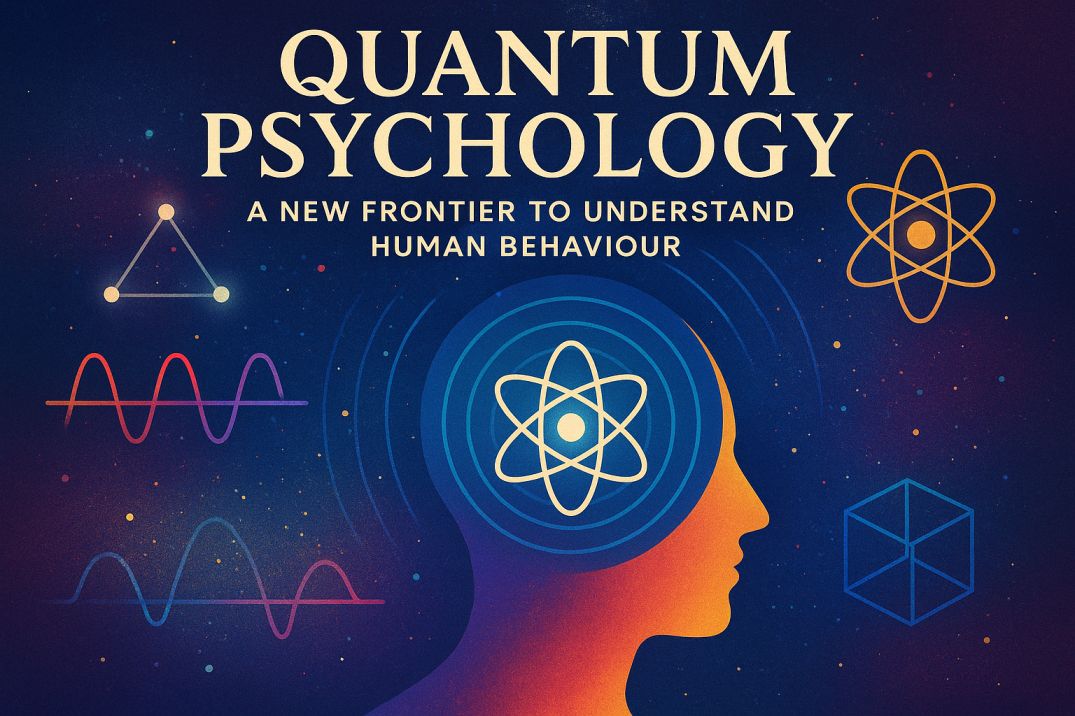
In today’s fast-paced world, where uncertainty is a constant companion, many individuals feel overwhelmed by stress, anxiety, and emotional turmoil. Conventional psychological models, which often assume human behaviour follows predictable patterns, sometimes fall short when explaining why emotions fluctuate or why motivation seems to appear and disappear without warning. Enter Quantum Psychology—an emerging field that takes inspiration from the principles of quantum physics to offer a fresh and nuanced understanding of how the human mind works.
Though quantum psychology might sound abstract or complex, its implications are practical and deeply relevant to the challenges people face in their daily lives. It explains why emotions and thought processes are dynamic and interconnected, providing insights that can improve mental health, education, relationships, and workplace dynamics.
What is Quantum Psychology?
Quantum psychology is an interdisciplinary approach that draws from quantum mechanics, the branch of physics that explains how particles at the smallest scale—like electrons and photons—behave in ways that challenge classical physics. These behaviours include phenomena such as:
Superposition: Particles can exist in multiple states simultaneously until observed.
Entanglement: Two particles become interconnected so that changes in one instantly affect the other, regardless of distance.
Quantum psychology applies these concepts metaphorically to human thought, emotion, and behaviour. Traditional psychological models often rely on linear cause-and-effect reasoning. For example, “If you study, you will perform well,” or “If you relax, you will feel calm.” However, quantum psychology argues that emotions and thoughts are not always linear or predictable. Instead, they fluctuate depending on internal and external factors, often existing in overlapping states of possibility until an event, interaction, or decision triggers a dominant feeling or thought.
Dr. Neeraj Panwar, Assistant Professor at CHRIST University, explains, “Quantum psychology helps us move beyond deterministic models and explore how the mind operates in probabilistic and interconnected ways. It suggests that feelings, motivations, and decisions are influenced by multiple forces, some of which we may not even be consciously aware of.”
This perspective opens the door to understanding why someone might feel motivated one moment and overwhelmed the next, or why relationships and learning processes do not always follow expected patterns.
Quantum Psychology vs Traditional Approaches
Feature
Traditional Psychology
Quantum Psychology
Assumption
Linear cause-effect
Non-linear, probabilistic
Emotional States
Stable or slowly changing
Fluctuating, overlapping
Motivation
Based on effort and discipline
Emerges from interactions of multiple factors
Measurement
Predictable
Context-dependent, requires dynamic tools
View of behaviour
Deterministic
Entangled and uncertain
Why It Matters for the Common Person
Quantum psychology is not just for scientists or academics—it has profound implications for everyday life. Whether you’re a student struggling to focus, a parent trying to support a child, or an employee feeling burned out, this approach offers tools to understand yourself and others more compassionately.
Mental Health: Understanding Emotional Swings
According to the World Health Organization, nearly 1 in 8 people globally live with some form of mental health disorder, such as anxiety or depression. Quantum psychology offers a new lens through which people can view their emotional experiences without judgment.
This insight allows people to accept fluctuating emotions without shame. For example, someone preparing for an exam might experience excitement, anxiety, and confusion all at once—a state quantum psychology would describe as a superposition of possibilities until one feeling becomes dominant.
Workplace Stress: Designing for Wellbeing
In today’s work environment, stress is a silent epidemic. A 2023 survey by the American Psychological Association found that 60% of employees reported work-related stress affecting their health. Quantum psychology reframes this by highlighting how environmental triggers—deadlines, interpersonal conflicts, or lack of recognition—interact with personal stress responses in unpredictable ways.
Human resource professionals and managers can benefit by designing tasks and goals that incorporate both challenge and satisfaction. Encouraging collaboration, autonomy, and purpose can help employees remain engaged without being overwhelmed.
Parenting and Education: Encouraging Joyful Learning
Parents and educators often struggle with students who resist learning or feel disconnected from schoolwork. Quantum psychology emphasizes that learning is not purely about discipline or reward systems—it’s about emotional resonance.
Creating enjoyable learning experiences that include choice, creativity, and interaction helps learners engage naturally. Dr. Panwar points out, “When learning environments trigger positive emotions, students are more likely to explore, take risks, and persist, even in challenging subjects.”
Learning, Flow, and Enjoyment: The Heart of Quantum Psychology
One of the most groundbreaking applications of quantum psychology is in education—especially in understanding motivation and engagement. A landmark study conducted by researcher Çelik (2025) involving Turkish high school students learning English as a foreign language (EFL) found that psychological flow alone did not predict academic engagement. Instead, enjoyment acted as a critical mediator.
Key Findings from the Study
Flow did not directly predict engagement (β = −0.105, p = 0.228).
Flow significantly predicted enjoyment (β = 0.518, p < 0.001).
Enjoyment strongly predicted academic engagement (β = 0.347, p < 0.001).
The indirect pathway (Flow → Enjoyment → Engagement) was significant (β = 0.180, p < 0.001).
In simpler terms, even if a student was deeply focused on a task (flow), that alone wasn’t enough to ensure participation. However, when the task was enjoyable, engagement increased significantly.
This finding aligns with Barbara Fredrickson’s broaden-and-build theory, which argues that positive emotions expand an individual’s attention and motivation, allowing for greater learning and creativity.
What Does This Mean for Students?
For students facing learning difficulties, this approach offers hope. Rather than blaming themselves for lack of focus or effort, they can recognize that emotional states like boredom or anxiety are natural responses that need nurturing.
For Teachers and Trainers
Educators are encouraged to design tasks that stimulate curiosity and provide immediate rewards like feedback, group activities, and opportunities for creative expression. These small changes can dramatically shift how students engage with material.
How Does This Relate to Daily Life?
Quantum psychology is not confined to therapy rooms or academic papers—it has practical applications that improve the way people navigate daily stressors, relationships, and decisions.
1. Mental Health Practices
- Mindfulness Exercises: By acknowledging that emotions are transient, individuals can practice observing their feelings without judgment.
- Self-Compassion: Understanding that mood fluctuations are normal can reduce self-criticism and promote healthier coping strategies.
- Therapeutic Approaches: Therapists can incorporate dynamic assessments that measure emotions in real time rather than relying solely on past patterns.
2. Workplace Wellbeing
- Flexible Goal Setting: Encouraging employees to set adaptable goals rather than rigid targets helps them cope with uncertainty.
- Supportive Communication: Managers can create environments where expressing emotions is accepted without stigma.
- Team Cohesion: Recognizing interconnected emotional states fosters empathy among coworkers.
3. Parenting and Education
- Learning Through Play: Introducing fun, interactive activities helps children stay motivated, especially in difficult subjects.
- Encouraging Exploration: Giving children space to explore interests without fear of failure mirrors quantum psychology’s idea of non-linear learning.
- Emotional Check-ins: Regular conversations about feelings build emotional intelligence and resilience.
4. Relationships
- Improved Communication: Understanding that emotions are interconnected allows couples and families to respond more sensitively to one another.
- Conflict Resolution: Recognizing that frustration or anger may stem from multiple triggers helps defuse tense situations.
- Building Trust: Open emotional sharing creates deeper bonds and strengthens relationships.
- The Road Ahead: Integrating Quantum Psychology into Science and Society
- Though still a developing field, quantum psychology offers promising insights that are being empirically tested and refined. Researchers recommend using longitudinal studies, mixed-method designs, and technology-based assessments to track emotional changes over time.
Some of the most exciting possibilities include:
AI-driven emotional tracking: Apps that analyze mood patterns could offer personalized recommendations based on context and behaviour.
Educational innovations: Schools can design curriculum models that incorporate emotional engagement as a core component of learning.
Public health initiatives: Campaigns can focus on emotional wellbeing alongside physical health, offering tools to navigate uncertainty.
Dr. Panwar emphasizes, “Quantum psychology is not about replacing traditional psychology—it’s about expanding it. By acknowledging the complex, unpredictable nature of human experience, we can build systems that are more supportive, compassionate, and adaptable.”
As conceptualised by researchers such as Busemeyer, Wang, Kyriazos, and Poga, quantum psychology stands at the cutting edge of psychological science, bridging physics and psychology to explore the non-linear, interconnected dynamics of mind and behaviour. Supported by emerging empirical evidence, it holds promise to deepen our understanding of human cognition, emotion, and engagement in real-world settings.
More exploration and cautious application are warranted, but quantum psychology opens exciting pathways toward capturing the rich complexity of human experience beyond classical.
Author: Dr. Neeraj Panwar, Assistant Professor, School of Psychological Sciences, CHRIST University, Delhi NCR Campus
A great information about a new field of psychology that is more about the extension of psychology with more effective and innovative ways, great information
Good Read. Well explained the basics of quantum psychology with examples. Would recommend.