
(Author: Afsara Shaheen)
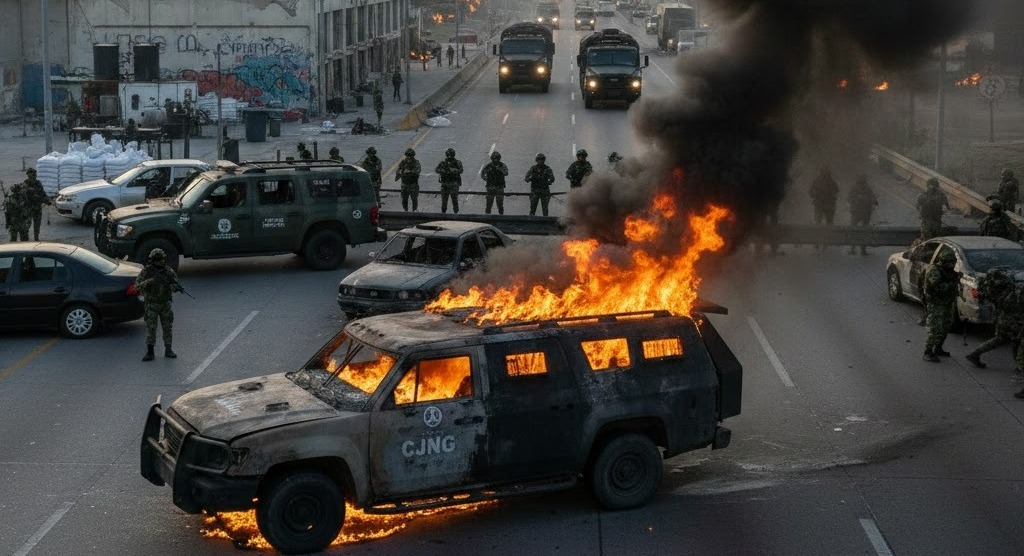
The killing of Jalisco New Generation Cartel (CJNG) leader Nemesio Oseguera Cervantes, alias “El Mencho”, in a February 23, 2026, security operation in Jalisco marks one of the most consequential blows against a Mexican cartel kingpin in recent years. Yet, as the immediate aftermath demonstrates, decapitation strikes against cartel leadership rarely translate into durable security gains. Within hours of his reported death from injuries sustained during an attempted arrest, coordinated retaliatory violence engulfed large parts of Mexico. At least 74 fatalities were reported, including 25 National Guard personnel, as cartel gunmen torched vehicles, blocked highways, and attacked commercial establishments across multiple states.
CJNG, founded in 2011 after a split from the Sinaloa network, rapidly evolved into one of Mexico’s most powerful and territorially expansive criminal organisations. Under Oseguera’s leadership, it combined extreme violence with paramilitary-style tactics, deploying armoured vehicles, heavy-calibre weapons and rocket launchers. The group built a diversified criminal portfolio: synthetic drug production – particularly fentanyl and methamphetamine – alongside extortion, fuel theft (huachicol), migrant smuggling, illegal mining and arms trafficking. CJNG’s operational footprint extended beyond Mexico into the United States, Latin America, Europe and Asia, reflecting the globalised nature of contemporary narcotics supply chains.
Mexico’s drug economy is deeply embedded in transnational demand structures. The United States remains the principal consumer market for Mexican-produced heroin, methamphetamine and synthetic opioids. American agencies have long provided intelligence, training and equipment to Mexican forces, under security cooperation frameworks. In the present operation, US officials acknowledged intelligence support, though Mexican President Claudia Sheinbaum emphasised that planning and execution were undertaken exclusively by federal forces. This calibrated messaging underscores the political sensitivity of overt US involvement, particularly amid periodic threats from Washington advocating direct action against cartels.
The scale of the drug trade underscores why leadership removals rarely prove decisive. Synthetic opioids such as fentanyl require limited agricultural inputs, depend on precursor chemicals – often sourced from Asia – and can be manufactured in clandestine urban laboratories. The profit margins are immense, sustaining resilient networks capable of rapid regeneration. Even when a dominant figure is eliminated, mid-level commanders and rival factions compete for territorial and logistical control, frequently triggering spikes in violence. Mexico’s experience following the killings or extraditions of figures such as Joaquín “El Chapo” Guzmán and other high-profile traffickers illustrates how fragmentation can intensify conflict without disrupting supply.
CJNG’s post-operation reaction – roadblocks, arson, attacks on infrastructure – reflects a deliberate strategy of coercive signalling. By paralysing mobility and commerce across states, including Jalisco, Michoacán and Guanajuato, the cartel sought to demonstrate both retaliatory capacity and territorial dominance. Such tactics serve dual purposes: deterring future state offensives and reassuring subordinate cells of organisational continuity. In several previous confrontations, CJNG units have exhibited military-grade coordination, including ambushes on security convoys and the use of improvised explosive devices.
Since the launch of Mexico’s militarised “war on drugs” in 2006, homicide rates and enforced disappearances have risen sharply, with well over half a million people reported killed or missing. While successive administrations have alternated rhetoric – from “kingpin strategy” to “hugs, not bullets” – security policy has continued to rely heavily on armed forces’ deployment. The structural drivers of cartel resilience, however, remain intact: entrenched corruption, weak local policing, socioeconomic inequality, cross-border firearms trafficking from the United States, and sustained drug demand.
El Mencho’s death may temporarily disrupt CJNG’s command structure, but it is unlikely to dismantle the economic architecture underpinning organised crime in Mexico. Instead, the more probable short-term trajectory is internecine struggle within the organisation or intensified confrontation with rival groups such as the Sinaloa Cartel. Unless accompanied by institutional reform, financial intelligence targeting money laundering networks, tighter controls on arms flows, and binational strategies addressing consumption patterns, leadership decapitation risks repeating a familiar cycle – symbolic victories followed by renewed fragmentation and violence. For Mexico, the episode reaffirms a hard lesson: tactical success against an individual cartel boss does not equate to strategic success against a deeply entrenched criminal ecosystem.
(Author is the Research Associate in Institute for Conflict Management)