
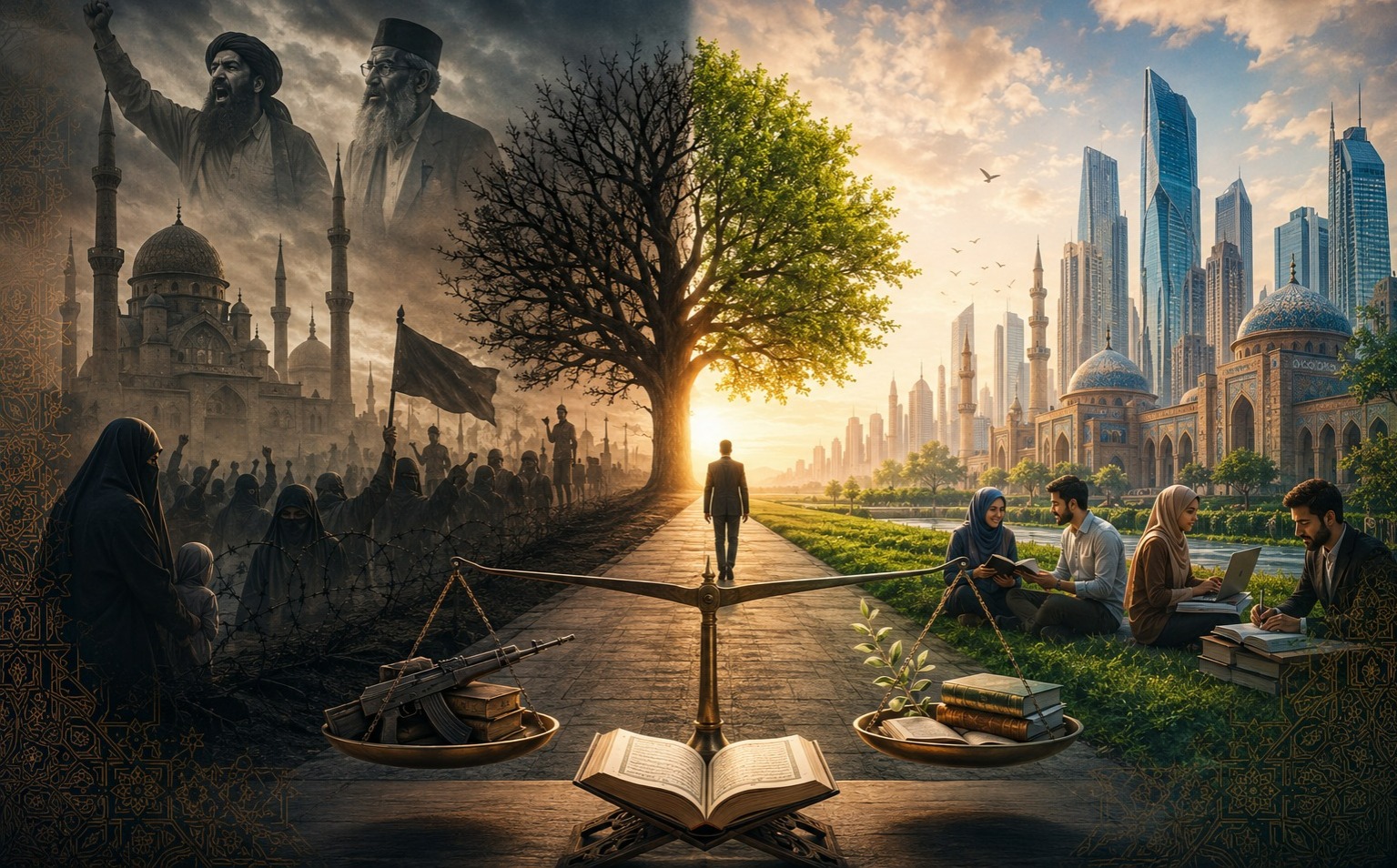
In an era defined by rapid technological advancement and global pluralism, the intersection of religion and governance remains one of the most volatile flashpoints of the 21st century. In a recent, thought-provoking dialogue hosted by The Milli Dialogue, Dr. Ishtiaq Ahmed, a renowned Swedish-Pakistani political scientist and Professor Emeritus at Stockholm University, dissected the complex evolution of “Political Islam” and its impact on the contemporary Muslim world.
Faith vs. Ideology
Professor Ahmed began by drawing a sharp distinction between Islam as a personal faith and Islam as a political ideology. He argued that the five pillars of Islam belief in Allah, prayer, fasting, charity, and the Hajj are inherently non-political “One can fulfill these obligations in Sweden, America, or Australia without the need for a specific political state,” Ahmed noted.
He traced the rise of modern “Fundamentalist Islam” to the colonial era, suggesting it emerged as a reaction to a sense of inferiority. Figures like Abul A’la Maududi in Pakistan and Sayyid Qutb in Egypt reimagined Islam not just as a faith, but as a totalitarian system influenced more by 20th-century Fascism and Communism than by liberal democratic values. According to Ahmed, this shift sought “total control” over every aspect of individual and social life, effectively stripping away personal freedoms
The Failure of the “Utopian” Model
The conversation took a critical turn toward the practical outcomes of these ideologies. Despite the existence of over 50 Muslim-majority nations, Ahmed argued that a successful “Islamic State” model that aligns with modern human rights and governance remains elusive. He cited the Taliban’s Afghanistan as a tragic example, where tribal customs are often conflated with religious law to justify the exclusion of women from education and public life
Even in wealthier nations, Ahmed observed a missed opportunity. He lamented that oil-rich nations in the Middle East chose to export sectarian extremism and fund conservative madrasas rather than investing in universal education and industrialization. “If they had used that wealth to build universities and provide scholarships for boys and girls, they could have stood alongside Western societies as a modern civilization,” he said
The “Ummah” and Realpolitik
One of the most poignant moments of the discussion centered on the concept of the “Ummah” (the global Muslim community) versus the reality of state interests. Ahmed highlighted the irony of Pakistan’s recent deportation of Afghan refugees many of whom had lived there for generations despite the rhetoric of religious brotherhood . Similarly, he noted how political rifts between Gulf nations often lead to the arbitrary expulsion of migrant workers based on their sect or nationality, proving that “Realpolitik” often triumphs over “Faith”
A Path Forward: Sufism and Secular Values
When asked if there is an alternative to the current friction, Ahmed pointed toward the “Unity of Creation” found in Sufi traditions. He advocated for a return to the values of humanism and pluralism, where the “Divine” is seen in all people, regardless of whether they follow Ram or Rahim.
Ahmed concluded with a powerful observation on the Western diaspora. With 20 million Muslims living in Western Europe, he noted that they enjoy freedoms religious, political, and social that are often denied in their home countries. He urged Muslim-majority nations to embrace the “Rule of Law” and equal rights for women and minorities, arguing that attempting to govern 21st-century societies using 7th-century values is a “failed formula”. As the dialogue ended, the message was clear: for Islam to flourish in the modern age, it must be disentangled from the pursuit of absolute political power and returned to its roots of spiritual guidance and universal human dignity.