
By Arun Srivastava
Quite intriguingly, how could Droupadi Murmu, the President of the Indian Republic and the highest constitutional authority of the country, allow herself to be used by Narendra Modi to advance his politico-electoral mission? Her actions can be questioned on at least three broader counts.
First, Murmu was sworn in as the 15th President of India on July 25, 2022. She also became the first person from a tribal community to hold the office. Yet she had never previously identified herself as the “daughter of Bengal,” a phrase Prime Minister Modi often deploys wherever he goes. The question arises: what message did she intend to convey to the tribal community—especially the Santals of Bengal—by describing herself in this way, particularly when it coincided with the upcoming Assembly elections in the state?
Her actions can be assessed on three broader contours.
First, during her visit to West Bengal, Murmu expressed concern about the welfare and development of tribal communities. She sought to know whether development benefits meant for tribal groups—particularly the Santal and Adivasi communities in North Bengal—were effectively reaching them, noting a lack of progress. As President, she cannot be faulted for raising such questions. The moot point, however, is why she chose to voice this disappointment just ahead of elections. Did she raise the same concern with Chief Minister Mamata Banerjee during the last four years of her presidency?
It sounded incongruous to hear her use Modi’s rhetoric of being the “daughter of Bengal.” If she indeed felt that connection, why did she not take up the issue of tribal welfare with the state government earlier, at least after becoming President?
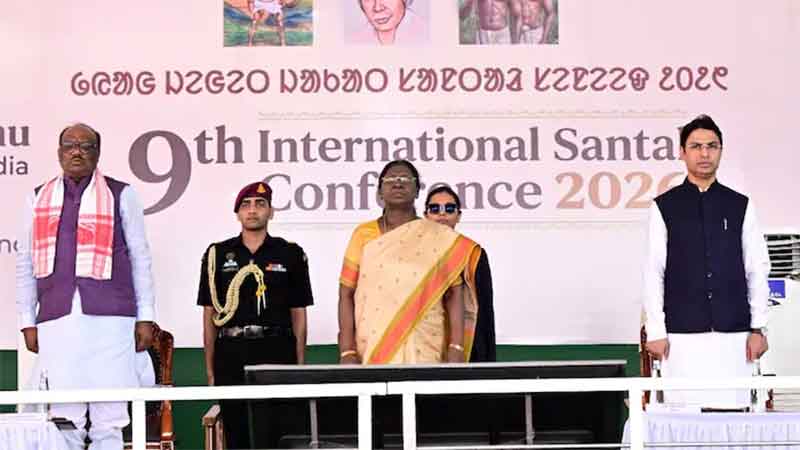
The President also expressed displeasure over the change of venue for the meeting. The venue had been shifted from Bidhannagar to Gossainpur (near Bagdogra Airport) due to security and administrative reasons cited by the state, which reportedly resulted in a lower turnout. In a surprise move, Murmu visited the original venue and remarked that there had been no reason to change the site. She said the earlier location could easily have accommodated several lakh people and that many members of the Santal community could not attend because the conference was held far from their area.
Murmu further expressed disappointment that no state minister was present to receive her, contrary to normal protocol. However, Trinamool Congress (TMC) leaders clarified that neither the Chief Minister nor her ministers were scheduled to attend, as the event was organized privately and their presence was not mandated. Instead of blowing the issue out of proportion, Murmu, as a matter of normal administrative practice, could have taken it up through official channels and sought clarification from the state government. At that moment, it appeared she forgot that she occupies the office of the President of India and must adhere to the decorum and prestige associated with it.
Her remarks were quickly seized upon by Modi and the BJP, who appeared ready to mount an attack. While the President expressed displeasure, she herself admitted uncertainty about why the situation had arisen or whether the state leadership was responsible. Yet in the same speech she reiterated that she considered herself a “daughter of Bengal.”
The episode created the impression that she was sending a message to the Adivasis and tribals of Bengal: look how the daughter of your state is being mistreated by another Bengali daughter in her own land.
The second count relates to the political response that followed. Modi fired his salvo within minutes of Murmu expressing her displeasure. The alacrity with which he reacted suggested he was ready to capitalize on the moment. He criticized the Mamata Banerjee government for “shameful” mismanagement and violation of protocol. Soon after, the Union Home Ministry led by Amit Shah—already engaged in a running feud with the West Bengal government—sought an explanation from the state administration regarding alleged protocol lapses during the President’s visit. A report was also requested on the last-minute change of venue.
Murmu’s remarks, however, must be viewed in context. Referring to the International Santal Conference, she said:
“Today was the International Santal Conference. When I came here after attending it, I realised it would have been better if it had been held here, because the area is so vast. I don’t know what went through the administration’s mind. They said the place was congested, but I think five lakh people could gather here easily.”
BJP leaders went further, attempting to create the impression that the state government had failed even in ensuring proper security arrangements.
The third count is the overt politicization of the episode. True to his style, Modi quickly linked the issue to the upcoming elections. Having exhausted much of his arsenal against Mamata Banerjee in previous electoral battles, he appeared to use the alleged “ill-treatment” of the President as a psychological weapon to undermine her in the eyes of Bengalis, particularly tribal voters. He described the incident as “shameful and unprecedented,” clearly aiming to stir tribal sentiment.
This strategy fits into the BJP’s approach to the 2026 West Bengal Assembly elections—highlighting governance failures and framing the incident as disrespect toward a tribal woman occupying the highest constitutional office. Modi alleged that the TMC government had “crossed all limits” and treated Santal culture casually. He framed the incident as a grave insult, declaring that “the people of West Bengal will not forgive the TMC.”
With the BJP steadily losing ground among tribal voters, Modi appears to be attempting to revive a narrative of neglect and exploitation. Historically, the BJP has not been particularly popular among tribal communities. Riding on nationalist sentiment after the Pulwama terror attack in which 40 CRPF personnel were killed, the party won 31 of the 47 seats reserved for Scheduled Tribes in earlier elections. But by 2024 it lost all five ST-reserved Lok Sabha seats in West Bengal.
Many tribal communities remain skeptical of the RSS–BJP’s Hindutva politics and fear threats to their land rights, cultural identity, and safety. Mamata Banerjee continues to enjoy considerable support in the tribal belt. In the 2016 Assembly elections, the TMC won 27 of the 30 seats in the tribal-dominated Jangalmahal region. In the 2021 elections, it won 10 of the 16 seats reserved for Scheduled Tribes.
The Modi–Shah leadership clearly intends to break this TMC stronghold. Rumours are already circulating in political circles that the alleged disrespect shown to the President could damage Mamata electorally. Although the BJP has made gains among tribal populations in states such as Chhattisgarh, Madhya Pradesh, Maharashtra and parts of the Northeast, it has not succeeded in consolidating that base in Jharkhand or West Bengal. While some tribal voters support the BJP due to nationalist rhetoric and welfare schemes, others oppose it because of concerns over land rights, forest conservation and the dilution of protective legislation such as the SC/ST Act.
In her speech, Murmu said:
“I do not think that Santals and other Adivasis in this area are fully progressing. The benefits of development have not reached you as they should.”
Mamata Banerjee responded sharply.
“Do you know how many tribals were deleted from the voter list in Bengal? Please find out about that as well and speak up against it,” she said, alleging that tribal voters were being singled out during voter list revision.
She added:
“I feel ashamed to even say this. We respect the Hon’ble President. But she, too, has been sent to play politics. I am sorry, Madam. I have great regard for you, but you are being guided by the BJP’s policies and instructions.”
Banerjee also rejected the allegation that the state government had ignored the President’s visit. She said Siliguri Mayor Gautam Deb had been present and that the event was organized by a private body rather than the state government.
Anticipating a political attack from the BJP leadership, Banerjee moved quickly to rebut Murmu’s allegations. She accused the President of acting “at the behest of the BJP” and advised her not to engage in politics ahead of the 2026 Assembly elections. The dispute soon escalated into a major political row.
“I am sorry Madam, I respect you greatly, but you have fallen into the BJP’s trap,” Banerjee said. She insisted the President had been received strictly according to the schedule approved by the President’s Secretariat and argued that the venue change was due to administrative constraints. She also questioned Murmu’s silence on alleged atrocities against tribals in BJP-ruled states such as Manipur and Chhattisgarh.
Regarding the Santal Conference, Banerjee said she had not been properly informed about the event and accused the BJP of trying to malign West Bengal by politicizing the highest constitutional office. At the time, she said, she was engaged in protests over voter rights and alleged that the Election Commission was acting under BJP influence.
The controversy has injected a new, emotionally charged dimension into the ongoing political rivalry between the Prime Minister and the Chief Minister of West Bengal.
Countering Murmu’s remarks, Banerjee listed several welfare measures undertaken by her government for tribal communities, particularly in the Jangalmahal region.
“Do you know that Santalis are organised here? Among tribals there are not only Santalis, but also Lodhas, Shabars, Mundas and many others,” she said.
She noted that the state government had given official recognition to the Ol Chiki script used for the Santali language and introduced it in education and competitive examinations.
Her criticism sharpened further when she said:
“When blood was being shed here in the name of the Naxalite movement, where were you and where was the BJP? Now that the situation is peaceful, the BJP has arrived. You occupy the highest constitutional position. Please do not play politics, especially during elections on the advice of the BJP.”
Banerjee referred to the troubled past of Jangalmahal during the Maoist insurgency and argued that peace and development returned only after her government assumed power.
Of the twelve years of the Modi government, Murmu has served as President for four. Critics argue that this period has also witnessed a rise in violence against tribal communities across India. Yet Murmu has rarely sought explanations from the central government regarding such incidents.
In Madhya Pradesh, which has India’s largest Scheduled Tribe population (around 15.31 million), tribal communities have faced increasing reports of repression and discrimination. Incidents cited include the 2023 Sidhi urination case, a man dragged to death in Neemuch, the Nemawar massacre in which five siblings were killed, and the burning of a tribal woman in Guna. In 2023, 25 houses belonging to Adivasi villagers were demolished without notice in Khandwa district.
Tribal women have been particularly vulnerable. In 2026, a sterilization camp in Dhar district allegedly subjected around 180 tribal women to unsafe medical procedures. According to National Crime Records Bureau data, Madhya Pradesh consistently ranks among the states with the highest number of crimes against tribals.
Murmu’s home state of Odisha has also witnessed significant displacement of tribal communities due to development projects. Nearly one million people have reportedly been displaced, with issues including declining tribal land ownership, forced gram sabhas for land diversion, and violations of the Forest Rights Act—especially in mining regions. Odisha is home to 13 Particularly Vulnerable Tribal Groups (PVTGs) among its 62 scheduled tribes.
Chhattisgarh has seen some of the highest conflict-related tribal fatalities. Data from the South Asia Terrorism Portal and the Ministry of Home Affairs indicate that between 2014 and early 2026, more than 2,000 Naxalites—many of them tribals or operating in tribal regions—have been killed in the state. In 2024 alone, 313 fatalities were recorded, marking a sharp spike in conflict-related deaths. Activists and local reports suggest that hundreds of tribals may also have been killed in crossfire or alleged fake encounters by security forces.
Source : Counter Currents .ORG