
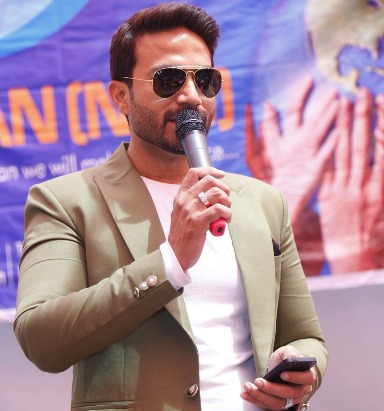
Shiraz Khan’s journey from the crowded lanes of Old Delhi to founding the non-profit “Yes, We Can” is a story of grit, reinvention, and a deep commitment to lifting others up. Today, his organisation stands as a beacon for those who feel unseen, proving that background does not limit destiny when courage meets purpose. Raised in a Muslim family in Old Delhi, Shiraz grew up in an environment that balanced tradition with modern education. He studied in an English-medium school while also attending a madrassa, eventually becoming a Hafiz by memorising the Quran, a process that instilled in him discipline, patience, and perseverance.
Even as he absorbed religious and cultural values, Shiraz nurtured a quiet restlessness and a desire to shape his own path. He did not want to depend on his father’s income or follow a conventional route, and this determination later defined his identity as a leader and social reformer. Shiraz’s professional journey began at a call centre, a job that might appear distant from social work but became a crucial training ground. The role sharpened his communication skills, built his confidence, and taught him how to connect with people from different walks of life. His creative side soon led him to a Delhi dance studio, where he found opportunities in modelling and discovered a new dream: acting. Driven by this aspiration, he moved to Mumbai, the hub of India’s entertainment industry, ready to face uncertainty in pursuit of his ambition.
Life in Mumbai was not easy; Shiraz dealt with financial and emotional hardships while chasing roles. Generous well-wishers offered him a place to stay rent-free and introduced him to industry circles, helping him build a network from scratch. Gradually, he earned roles in television serials and reality shows, experiencing a version of success that once felt distant from his Old Delhi upbringing. However, when the COVID-19 pandemic brought the entertainment world to a standstill, it also gave Shiraz the time to reassess what success truly meant.
During the pandemic, encouraged by a friend, Shiraz turned to podcasting as a new medium to communicate and listen. Through meaningful conversations, he realised that real fulfilment lay not in fame but in inspiring and supporting others through their struggles. This insight led to the creation of “Yes, We Can,” co-founded with his friend Nandish as a response to the isolation and uncertainty of the time. Though formally shaped during the pandemic, the idea had been germinating since 2015, when both founders sensed that people needed more than material aid they needed encouragement, guidance, and a sense of belonging.
“Yes, We Can” is dedicated to empowering communities, especially youth, by creating safe spaces where they can grow and dream without fear. The organisation offers moral and financial support to underprivileged students and extends specialised care to differently abled children through professional physical and psychological assistance. To channel the energy of young people positively, the organisation also runs a sports coaching centre for cricket and football. In a society often divided by class, religion, or background, its initiatives highlight unity, shared strength, and equal opportunity.
Over time, “Yes, We Can” has evolved from a small initiative into a vibrant platform where possibility meets purpose. It conducts grassroots awareness drives, collaborates with youth groups, and partners with schools to mentor and motivate young minds. The core philosophy of the organisation is not charity but empowerment. By focusing on resilience rather than dependency, it helps individuals build confidence and capability, reminding them that their dreams are valid and achievable.
Shiraz’s own life transitioning from a Hafiz in Old Delhi to a model and actor in Mumbai, and then to a social entrepreneur has deepened his empathy for those starting over. Each shift in his journey reinforces his belief that personal growth and social change go hand in hand.
Looking ahead, he envisions expanding “Yes, We Can” across India, building partnerships with schools, community leaders, and youth networks to create a nationwide movement of empowerment. Alongside this, he plans to grow his podcasting work to spotlight unheard stories, merging creativity with service while carrying a simple yet powerful message: transformation begins with the belief that “yes, we can.”