

As part of the Distinguished Lecture Series, the Sarojini Naidu Centre for Women’s Studies hosted Professor Vrinda Dalmia from the University of Hawaiʻi at Mānoai for a lecture titled “The Wisdom of Greek: Mahabharata’s Book of the Women.” The session explored comparative feminist philosophy, situating the Sri Parva chapter of the Mahabharata within care ethics theory. Professor Dalmia examined how the public display of female grief on the battlefield functions as both epistemological and political intervention, offering alternative knowledge about vulnerability, relationality, and the ethics of everyday care.
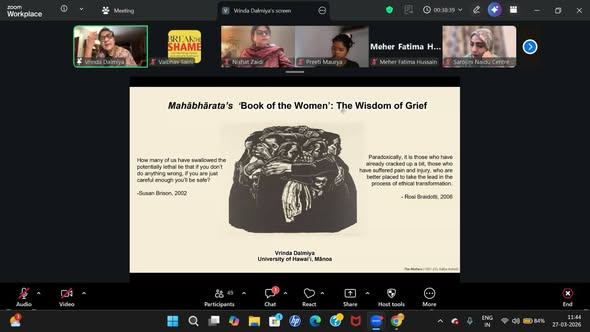
Ms. Preeti Maurya PhD scholar at the Sarojini Naidu Centre for Women’s Studies opened the session followed by a welcome address and introduction of Professor Dalmia by Prof. Nishat Zaidi, Honorary Director of the Centre. Professor Dalmia traced how women’s collective lamentation challenges traditional moral frameworks, arguing that grief itself can serve as a form of ethical reasoning. She emphasized that the paradox of dharma and the politics of vulnerability open pathways for decolonial feminist ethics, expanding care theory beyond its Western origins. She situated her analysis within comparative feminist philosophy, explaining care ethics’ origins in Western feminist thought of the 1980s and exploring how Indian texts like the Mahabharata can enrich its principles. She focused on vulnerability, embodied subjects, and relationality as she outlined the political implications of a “politics of vulnerability.”
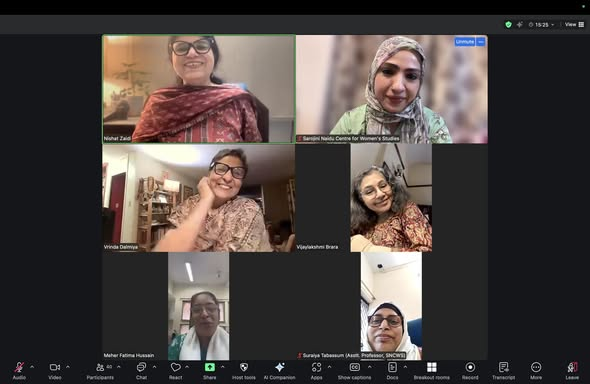
The lecture generated extensive discussion, with participants probing themes such as the role of grief in knowledge formation, the epistemic challenge posed by women’s voices in war narratives, and the potential of Indian philosophical texts to enrich global feminist ethics. Professor Dalmia responded by highlighting the importance of relational dynamics, interdependence, and power negotiations in care ethics, while underscoring the need to recognize women’s grief as a transformative epistemic resource.
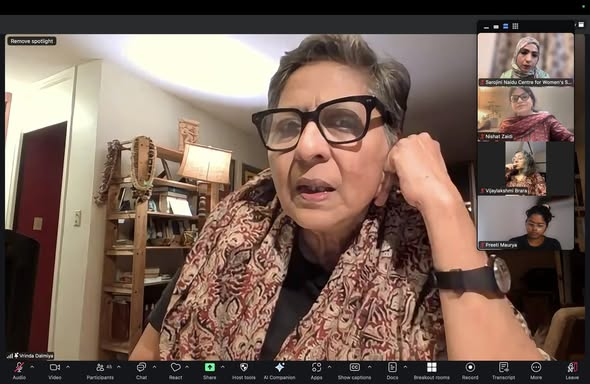
The session concluded with remarks from Prof. Nishat Zaidi and a lively Q&A which allowed faculty and students to engage deeply with the intersections of feminist philosophy, ethics of care, and decolonial thought. Dr Amina Hussain, coordinator of Distinguished Lecture Series proposed a vote of thanks.
The Distinguished Lecture Series at Sarojini Naidu Centre for Women’s Studies continues to serve as a vital platform for scholarly exchange, fostering interdisciplinary dialogue and advancing critical perspectives in feminist research.
Source : Jamia Millia Islamia, New Delhi