
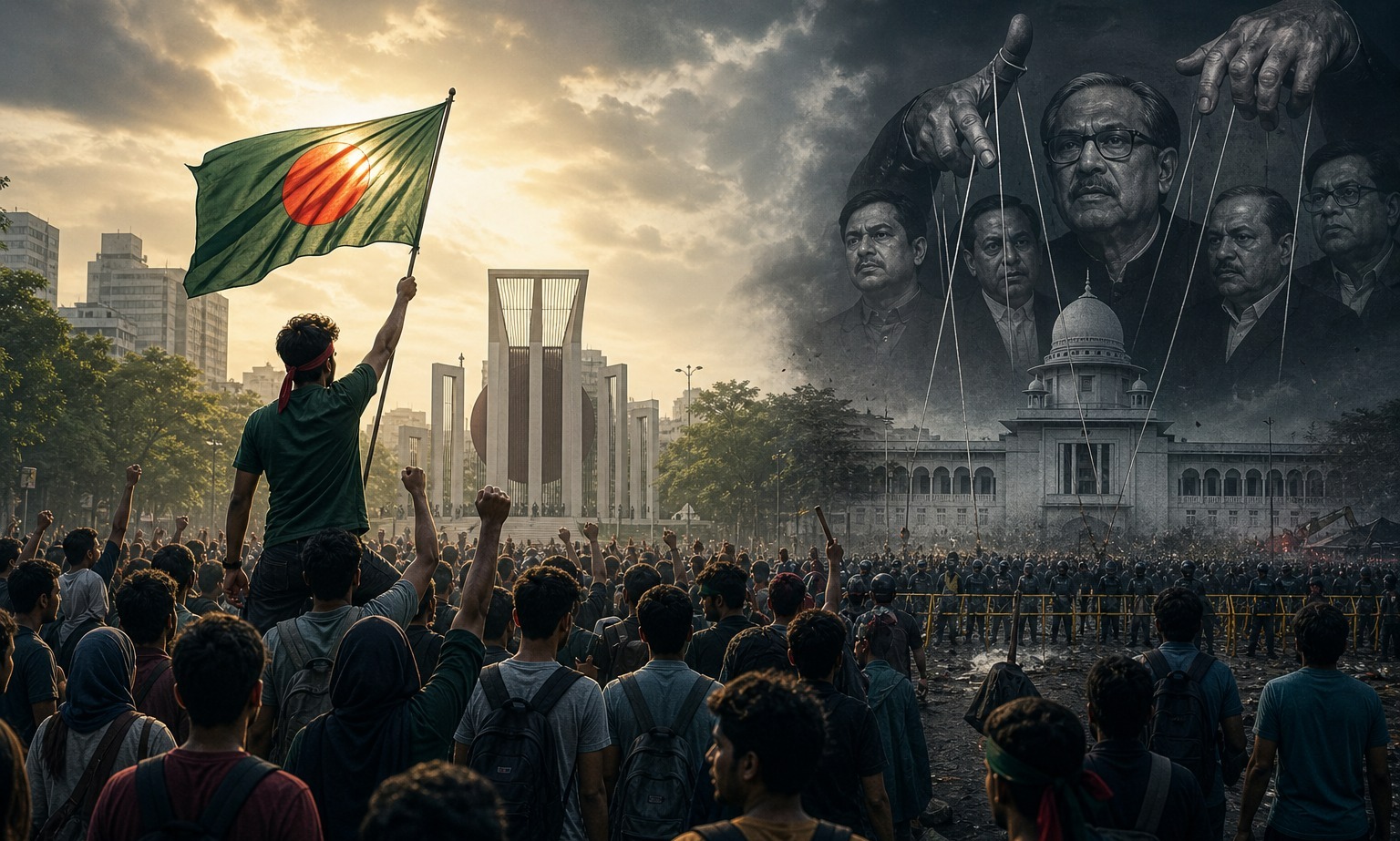
In 2024, the streets of Dhaka became the epicenter of a powerful student-led uprising that captured national and international attention. What began as a protest against the government’s job quota system soon evolved into a broader call for systemic reform, accountability, and a reimagined political future. For many, it was the dawn of a “New Bangladesh.” Today, however, that dream appears to be fading—replaced by disillusionment, fragmentation, and a harsh confrontation with political reality.
At its core, the movement was driven by a generation that felt excluded from opportunity and suffocated by entrenched systems of patronage. The quota system became a symbol of deeper structural inequalities, and students took to the streets not just to demand policy change, but to challenge an entire governance framework. Their courage and clarity of purpose galvanized public support, transforming a policy protest into a nationwide movement.
The state’s response was swift and severe. Crackdowns, violence, and loss of life underscored the risks inherent in challenging entrenched power. Yet, the intensity of the protests eventually forced a political transition, raising hopes that meaningful reform would follow. For a brief moment, it seemed that Bangladesh stood on the threshold of a transformative era.
But revolutions are often judged not by how they begin, but by what they deliver. In the aftermath, the formation of an interim setup and promises of systemic reform generated optimism. However, progress soon stalled. Reforms moved at a sluggish pace, and the re-emergence of old political actors signaled a return to familiar patterns. The very structures the students had sought to dismantle appeared to be reasserting themselves.
This is where the movement’s moral energy began to dissipate. Many young activists now feel sidelined—reduced from agents of change to spectators in a process they helped initiate. The sense of ownership that once fueled the protests has given way to a feeling of being used, even betrayed. Their demands for transparency, inclusivity, and institutional overhaul remain largely unmet.
Part of the problem lies in the inherent complexity of political transitions. Mass mobilization can topple or shake regimes, but building sustainable institutions requires negotiation, compromise, and time—often more time than impatient publics are willing to grant. Moreover, entrenched political elites possess the experience, networks, and resources to reclaim influence once the immediate pressure subsides.
Another challenge is the absence of a cohesive post-movement strategy. While the protests were unified in opposition, they lacked a clear, shared roadmap for governance after change. This vacuum created space for traditional political forces to re-enter and dominate the narrative. Without institutional anchors or organized leadership structures, the student movement struggled to translate street power into political capital.
Yet, to frame the movement as a failure would be both premature and unfair. It succeeded in reshaping public discourse, exposing systemic flaws, and demonstrating the power of youth mobilization. It also revealed a critical truth: that political transformation is not a single event, but a prolonged and often uneven process.
The current moment in Bangladesh reflects a broader global pattern. From the Arab Spring to other youth-driven protests worldwide, the trajectory often follows a similar arc—initial euphoria, followed by institutional resistance, and eventual recalibration. The challenge is not merely to ignite change, but to sustain and institutionalize it.
For Bangladesh’s young activists, the path forward may lie not in abandoning the movement, but in rethinking strategy. Engagement with formal political processes, building independent institutions, and fostering long-term leadership could help bridge the gap between protest and policy. Change, after all, is rarely linear.
The story of the 2024 student movement is still being written. Its dreams may be bruised, but they are not entirely broken. Whether they can be revived depends on the ability of its leaders—and the nation—to learn from this moment of disillusionment and chart a more resilient path toward reform.